

The article about the Hawaiian Huna Philosophy This is one of the most read posts here on my website.
I believe that this has to do with the fact that many people are looking for answers that help them to better understand themselves and the world around them.
Answers that make sense – because people need meaning in their lives.
I even believe that this desire for a higher meaning in life is firmly embedded in us humans. And that this is the root of all spiritual action of man.
In the past, this desire was satisfied by religions. After they – at least in our culture – have increasingly lost this function, it was the consumption frenzy of our affluent society that filled up the resulting meaninglessness in the short term.
But even that doesn't really work anymore and many people think about the "big questions of life" without really finding answers.
The Huna philosophy with its 7 principles, as I have described it in the aforementioned article, offers a good and clear orientation framework that can help to find coherent answers to these questions for oneself.
Another important concept from Huna is the four planes of reality, which will be discussed in this article.
What is reality?
Actually, that's quite clear. Reality is the "hard reality". What I can see and touch. The facts and circumstances that are there.
Reality is the "objective reality". And it is just the way it is.
But wait, is it really that simple?
The American writer Anaïs Nin once said:
"We don't see the world as it is. We see them as we are."
– Anaïs Nin
Could reality – or at least ours reality – perhaps something completely different from what we commonly assume?
The filter of perception
In NLP, neurolinguistic programming (a coaching direction), there is the famous saying "The map is not the territory". In German: The map is not the country or the landscape.
What does that mean?
If we have a hiking map on which mountains, rivers, paths and special viewpoints are drawn, then the symbols on the map correspond to reality.

But they are not reality. They are just a reflection of reality, but not reality itself.
It is the same with our "inner maps", the neuronal maps in our brain.
Neural maps
As humans, we perceive the world out there mainly through our eyes.
But they already filter out part of reality. This is because our eyes can only perceive and process a relatively limited spectrum of electromagnetic radiation, namely visible light (approx. 400-800 nm wavelength).
Ultraviolet and infrared light, on the other hand, cannot be detected – unlike some animals.
For this reason alone, we "see" the world with completely different eyes than many other living beings.
The same applies to our other senses, which also perceive only a part of reality.
In NLP, therefore, one also speaks of the so-called perception filters.
And they ensure that "our" reality is not the "real" reality (you can find more about how our brain perceives reality in in this article by mdr Wissen).
So we make an inner map of the world and believe that this is reality.
Aber: The map is not the territory!
And it gets worse (or better – depending on how you look at it).
Because we not only have external perceptual filters in the form of our sensory organs, but also inner perceptual filters.
Assumptions about the world
These inner perceptual filters are the assumptions, beliefs and also prejudices that we have about the world out there.
We can be aware of these (then they usually don't have such a strong effect) or we are not aware of them.
Then they work in our subconscious and direct our perception to the things we (unconsciously) want to see – and at the same time block out the things we don't want to see.
We "make the world the way we like it", to use Astrid Lindgren and Pipi Longstocking.
And who doesn't know it, the "rose-colored glasses" with which some people go through the world?
Of course, there is also the opposite, the "gray-black glasses", about which you don't hear so much, but with which many people also look at the world.
This is exactly what Anaïs Nin means when she says that we see things as we are.
The most famous formula in the world
But even if you stick to the "hard science", the reality is by no means as real as we usually assume.
Because the matter itself, of which reality is made, is not as tangible as it seems.
You've probably heard Albert Einstein's famous formula E = mc 2 seen somewhere.
I don't know of any other formula from physics that has managed to get almost a pop art character.
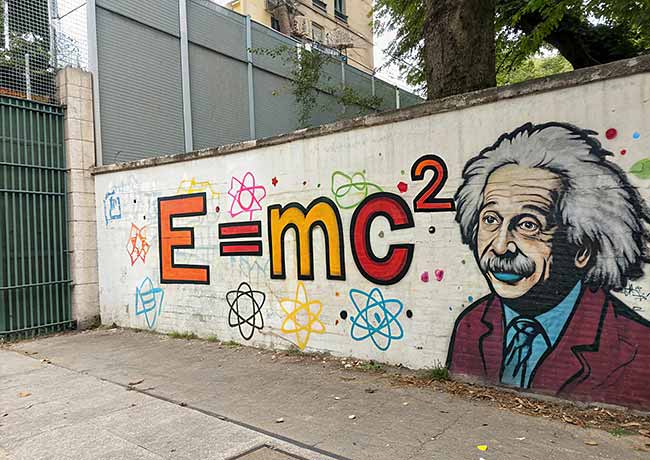
The "E" in the formula stands for energy, the "m" for mass and "c" is a constant, namely the speed of light.
The formula states that energy and mass are interchangeable, i.e. equivalent.
In other words, the whole world is made up of energy, and matter is just a very "condensed" form of energy.
And energy is always in flux – and can be "influenced".
Reality is malleable
This makes reality much less rigid and fixed than one might think. In fact, in my view, reality is more like a viscous mass that we can shape and shape.
How? First and foremost, of course, through our actions, but also through our thoughts and the emotions associated with them.
Remember the first principle of Huna philosophy: "The world is what we think it is." (Ike).
The Communications Engineer Jörg Starkmuth has written a book on this subject, which I can highly recommend to you if you are interested in the scientific background of such a view of the world.
The book is called " The emergence of reality ” (Advertising) and consists of two parts.
In the first part, the author describes the developments and findings of theoretical physics of the last years and decades and presents the most important theories from them (general and special theory of relativity, quantum mechanics, physical understanding of time, etc.).
The first part requires some perseverance to read, but it's definitely worth it. In the second part, Jörg Starkmuth uses all these preliminary considerations to create a modern world view that takes into account the current state of knowledge in modern physics and science.
And which comes surprisingly close to the traditional views of many indigenous peoples – and also has an astonishing number of parallels to the Hawaiian Huna philosophy.
And this leads me to the four planes of reality as found in the Huna philosophy.
Change of Perspective – The 4 Levels of Reality from the Huna Philosophy
In principle, reality can be viewed and interpreted from an infinite number of perspectives. In Huna philosophy, four such "levels of interpretation" have been chosen.
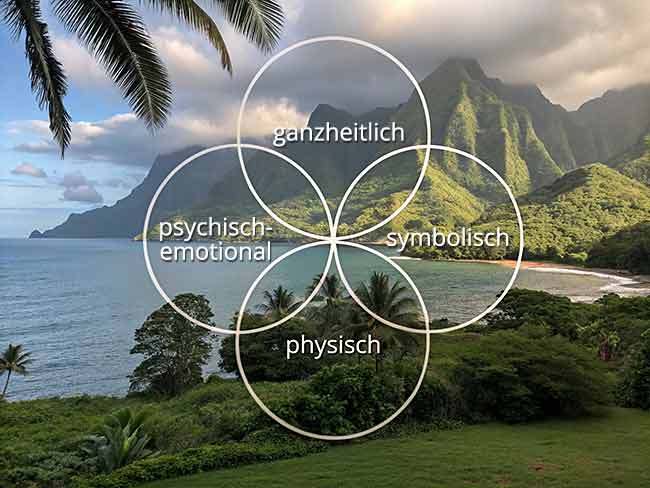
These four levels or perspectives on the world make it possible to deal very flexibly with one's experiences and open up many possibilities for action that one would have to do without if one only looked at the world from a single perspective.
In fact, that's exactly what we do in our Western, rational world. We limit our view of the world to a level that is described in Huna. Individual Information – the physical world.
The Physical Plane (Ike Papakahi)
On this first level of reality, everything is separate from each other. Here I am, there are the others. There is a tree here, a flower there and a river flows a little further away.
There is a table, a chair and a TV. All things are separate from each other and everything has a beginning and an end.
Everything can therefore be analyzed and "grasped" with the mind.
There is past, present and future, because these are also separate from each other.
The physical world is the world of rationality and science. And it is the worldview (= view of the world) on which our entire civilization is built and which was therefore placed in the cradle of each of us, so to speak.
And that's basically not a bad thing. Looking at the world from this first level actually has a lot of advantages.
Technical achievements that make our lives easier were only possible because we recognized and made use of the fundamental processes of physics, chemistry and other natural sciences on this level of reality.
Without the insights on the physical plane of reality, you would not be able to read this text at all, because the invention of the Internet also happened on this rational view of reality.
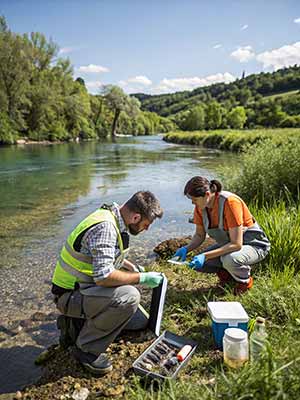
Even when biologists study an ecosystem, they do so on this first level of reality. For example, they try to understand which environmental factors are important for survival for a particular animal species and how the population of one species affects the population of other species.
The physical level of reality is an important building block for understanding the world around us.
What we usually forget, however, is that this view of the world is only one of the many ways in which one can look at the world.
Another way to look at the world is called in Huna Ike Papalua. It is the second level of reality and it is the level of the psyche, the feelings and the intuitions.
The psycho-emotional level (Ike Papalua)
The second level of reality is the level of the mind, our feelings and our emotions. It is the level of the Aloha-Spirits – the all-unifying power of love for which Hawaii is known ("Hawaii – The Aloha State").
This second level of reality is also the level of intuitive knowledge and wisdom within us. And it is the level of energy and "tuning in" to something.

At this level, everything is connected to everything else, because energy is limitless and spreads infinitely.
The second level of reality considers everything in this world to be alive, because everything is an expression of an all-encompassing, universal consciousness.
Everything in this world therefore has some kind of consciousness and reacts in some way to its environment.
In Huna it is said:
"Everything is alive, aware and responsive."
(In German: Everything is alive, conscious and reactive).
And this applies not only to plants, animals and humans, but to everything in this world. So also for the mountains, the clouds, the water and even for all objects that are made by humans.
Why?
Because all matter has its origin in this all-encompassing creator consciousness – a view that is quite compatible with the findings of modern physics, as Jörg Starkmuth explains in the already mentioned book on the origin of reality.
On this second level of reality, I can therefore speak to a tree or a river.
Of course, nature will not respond audibly through words. That would be the view of the first level. Communication on the second level of reality takes place through emotions, feelings and intuitive knowledge.
It is a quiet, subtle communication that we usually perceive unconsciously and then translate into words or inner images.
In this way, indigenous cultures have been communicating with the world around them for many millennia.
Insertion: Intuitive communication in computer science lessons
I once had a very impressive experience at school (as you may know, I am a teacher in my main job).
Many years ago, I once had a computer science course that was composed of different classes. Some of the students (about 14 years old) did not know each other and we only saw each other once a week for the two hours of computer science lessons.
At the beginning of the lesson, everyone always gets up and we wish each other a good morning. This was also the case on the day when I was able to experience how real this unconscious, intuitive form of communication actually is.
The students all stood up, I called out a cheerful "Good morning!" to the class and everyone answered in chorus "Aloha!".
I was somewhat taken aback, because saying "Aloha" is the way to greet each other in Hawaii – the birthplace of the Huna philosophy.
And indeed, at that time I had dealt very intensively with the Huna philosophy, read many books, attended courses and met once a week on the Internet with a group of like-minded people under the guidance of Serge Kahili King.
The problem: Of course, I had never told the students anything about it.
And when I asked, the students told me that they didn't know what "Aloha" meant and that she hadn't consulted either. The students also didn't know what had just happened.
When I later told Serge Kahili King about it, the matter was very simple for him:
Because I had dealt so intensively with Hawaii and the Huna philosophy (in which the Aloha spirit plays a central role), I simply radiated this information on a subconscious level.
The students perceived this intuitively. And this unconscious perception then mutually strengthened in the class, so that in the end the joint "Aloha!" could be formed.
The example from school refers to the subtle and silent communication between people and not to communication, for example, with a tree or the clouds, but in my opinion it shows very impressively that there is a flow of information on a level that we are not normally aware of – because we are simply used to to look at things only from a "first-level" perspective.
But there are two other levels of reality in Huna. In other words, two more ways to look at the world.
The third level of reality is the symbolic or symbolic level. In Huna they are called Ike Papakolu .
The Symbolic Plain (Ike Papakolu)
The following poem has been handed down from Zhuangzi, a Chinese philsophist who lived in the 4th century AD and who is one of the most famous representatives of Taoism:
Last night I dreamed,
I'd be a butterfly
and flew from flower to flower.
Then I awoke, and behold:
It was all just a dream.
Now I don't know:
I'm a person who dreamed,
he is a butterfly,
or am I a butterfly,
who dreams that he is a man?
Zhuangzi
On the third level of reality, sometimes referred to as the "shamanic level", everything is a dream.
Everything is a dream
We dream of our reality and everything we see is therefore part of our own dream.
If we change our dream, our reality will also change.
This is somewhat reminiscent of the Dreamtime of the Aborigines, which forms the basis of the spiritual worldview of the indigenous people of Australia.
But there are also signs of this view of the world in our own use of language.
We hope for the fulfillment of our dreams, create our dream life and dream of success and wealth.

Because on this level of reality everything is our own dream, everything in this world also has a symbolic meaning for us.
Cloud formations can thus become a sign of the success or failure of our plans and intentions.
Of course, this makes no sense if I look at the world from the point of view of the first level. There, cloud formations are formed by condensation of water, temperature differences and wind.
If I consider the whole world as (my) dream, then it makes perfect sense.
But just as there are no fixed meanings for our dream images in our nocturnal dreams, we also decide in the "waking dream of life" what meaning we give to the various symbols in our lives – and thus change our reality.
Symbols – the language of dreams
Ike Papakolu, the third level of reality in Huna, is also the level on which talismans and amulets work – because these are symbols that stand for health, strength or protection, for example.
And symbols are the language of our dreams.
The " "Gargoyles", depictions of demons that are often found in Christian churches, have an effect on this symbolic level.
Car brands such as Ferrari (prancing horse), Peugeot (lion) or Lamborghini (bull) use the symbolic power of animals to transport certain characteristics and make them usable for their own image.
In homeopathy, globules are used that are diluted during production to such an extent that no detectable amounts of the original substance are left.
Of course, it makes no sense to look at homeopathy from the point of view of the first level, because at this level there is no longer any active ingredient that comes into play.
On the symbolic level, however, the globules continue to contain the information content necessary to treat a disease.
Everything is a dream and we are not only the dreamers, but we are also the ones who give meaning to our dream – this is the view of the third level of reality in Huna.
The Holistic Level (Ike Papaha)
The 4th level of Huna philosophy emphasizes the oneness of all things. On this holistic level (sometimes referred to as the mystical level), everything is one.
Everything in this world is an aspect of an all-encompassing Greater Whole.
At this level, there is no you and no I. We are all only manifestations of an infinite, all-encompassing consciousness.
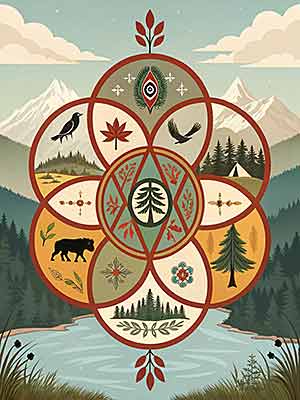
This applies not only to humans, but also to plants, animals and everything else in this world.
The fourth level of Huna philosophy also emphasizes the interconnectedness of all things.
However, on this holistic level, the different individuals are not connected to each other, but rather the individuals are expressions of the one big picture.
The fourth level is the level of spirituality, which is the primordial ground of all things.
It is the level on which mystics of all religions try to attain enlightenment through the realization of oneness with the divine through meditation and contemplation.
When Jesus says in the New Testament: "Inasmuch as you did it to one of the least of these my brethren, you did it to me." (Matthew 25:40), then this reflects this fourth level of reality.
And it includes – at least from the point of view of the Huna philosophy – everything in this world. "Brothers" therefore refers not only to fellow human beings, but to the whole of creation – because everything is an aspect of the same all-encompassing consciousness.
You have now got an overview of the four planes of reality from the Huna philosophy.
Now let's take a look at how we can positively influence our reality (our world of experience) through different actions on these four levels.
The four levels in practice
Imagine you regularly experience a lot of stress at work. This is a situation that probably happens relatively regularly for most of us.
Now let's think about how to deal with this problem on the different levels of reality.
The Physical Plane
Most of the techniques of classical stress management, as offered in seminars and courses, are located on the first level of reality (remember, at this level everything is separate from each other).
Of course, in order to work on your stress problem on the physical level, you should first become aware that you are stressed by something.
Sounds banal, but in practice it is often the first hurdle.

Because often we don't even notice that we are under stress. Especially if it lasts for a longer period of time, we get used to stress as our normal state.
In the end, all too often, there is burnout.
If you are aware that stress is a problem, you should think about what exactly triggers the stress in you. Identify the external stressors in your life and then think about how you might be able to deal with these stressors better.
This is not always easy and sometimes there seem to be few alternatives, e.g. if the workload is permanently too high due to the specifications of the company management.
Nevertheless, you should try to find ways to better deal with your stressors.
For example, you could get information about time management techniques or learn how to use productivity techniques to improve your effectiveness.
This includes, for example, taking regular breaks. In the end, they even save time because you can work more effectively afterwards.
At the same time, you could make sure that you replenish your resources regularly.
Relaxation techniques, joint activities with friends, regular visits to the sauna and, of course, spending time in nature are suitable means of recharging your batteries and energy.
You can see that you can do a lot on the first level of reality alone to effectively counteract stress.
However, if you follow the concept of the four levels of reality, you have a variety of other options.
The psycho-emotional level
On the psycho-emotional level, of course, the first thing you could do is consciously deal with your feelings in relation to the stress you experienced.
Self-reflection is therefore an important keyword for dealing with stress at this level.
Because until we are clear about our feelings and emotions (and accept them = acknowledge them as they are), we cannot change them.
"Feelings want to be felt," my NLP instructor once said. And that's exactly what this level is all about: allowing and perceiving one's own feelings and thereby transforming them.
But the second level of reality offers many more ways to deal with the stress experienced.
An important one of these are the so-called "blessings", which play an important role in Huna.
The Power of Blessing in Huna Philosophy
"To bless" means "to bless". Not necessarily in the religious sense, as we usually use the word, but in the sense of appreciating, admiring and looking at it with respect and love.
The idea behind it: The things I focus on will increase in my life – and the more emotions are involved, the sooner they are.
And positive emotions are even more effective than negative emotions due to the aloha principle.
By blessing the things we want to do in our lives, we increase the likelihood that those things can actually manifest in our lives.
For example, you could bless all the resources that will help you cope better with stress:
- I bless my ability to work productively.
- I bless my colleague for remaining calm and composed even under great pressure.
- I bless all people who go through life with strength and energy.
- I bless my work for helping me feed my family.
- I bless the power of trees to withstand even the strongest storms.
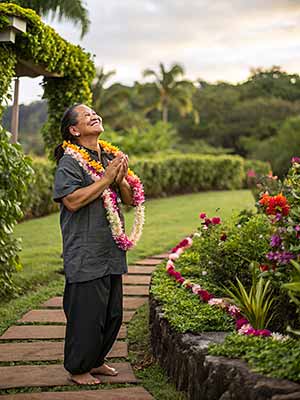
You can bless anything that helps you deal with stress better. You can also find many resources for this in nature.
The effect may not be instantaneous, but if you have been blessing things that can help you in this way for a while, you will notice a change.
If blessing seems a bit strange to you:
Simply replace the word "bless" with other words such as admire, acknowledge, or appreciate.
You may also find other words. Let yourself be guided by your feelings and use what works best for you.
The symbolic level
On the symbolic level, we consider life and our reality to be a dream. And the language of our dreams is symbols.
If we change the symbols, we change our reality. And there are many ways to do that
Affirmations and visualizations
For example, you could work with affirmations and visualizations to better cope with the stress at work.
Because inner images and affirmations are ultimately nothing more than symbols that stand for aspects of our reality.
If we change the symbols, reality also changes.
Because on the third level of reality, everything is a dream. If we change the symbols of this dream, we also change reality.
For example, you could say to yourself a phrase like "Every day I cope a little better with the stress I encounter at work" several times a day.
Or you can work with so-called "Silent Subliminals". These are audio recordings of such affirmations, which are played in a frequency range that we consciously do not perceive and which thus reach the subconscious particularly effectively.
Silent subliminals are not scientifically confirmed, but it is definitely worth a try.
Guided meditations and fantasy journeys
Guided meditations and especially fantasy journeys often work on the symbolic level and are good tools to better deal with all the stress that surrounds us every day.
An easy way to cope with stress on a symbolic level: Think about what could be an image of relaxation and harmony for you.
Then get a picture of it (for example, a quiet, clear mountain lake) and hang it up in your home (or maybe even at your workplace).
Take a few minutes a day to look at the picture and let it have an emotional effect on you.
Rituals are also symbols
Another "symbol technique": rituals.
Rituals are symbolic actions that often have a very profound effect on our subconscious and thus have an influence on our experience of reality.
For example, you could think of a "work completion ritual" that you perform every day after work to leave the stress and worries of work in your workplace.
As you can see, there are countless possibilities and techniques to shape and change reality on the symbolic level of reality.
I don't want to withhold another – somewhat special – technique from the Huna philosophy from you.
Working with Thoughtforms
It's about the so-called "Thoughtforms". And they work like this:
Create something in your mind that will help you deal with stress at work.
Imagine your thoughtform as real as possible in your mind's eye.
Then place this thought form in the room where it will help you best.

For example, you could imagine how there are many plants scattered all over your office.
In reality, they actually have a positive influence on our life of stress, there are a number of studies on this. So why not also as a pure thought-form?
In my experience, such "thoughforms" often work very well.
For example, as a teacher in somewhat more "demanding" classes, I have worked with this technique to create a positive working atmosphere – often with very good success.
So be sure to try it out for yourself.
The holistic level
On the fourth level – the holistic, holistic – we look at life as a whole. Stress at work thus becomes part of a larger life context.
Recognizing one's own vision of life
What do you want in your life real achieve? What is your vision (version) of a happy life? What are your dreams, wishes and goals? What is your greater life mission in this life?
And:
What does stress at work tell you about all these questions?
With these questions in mind, stress becomes an indication of what is going well in life and where we should change something – similar to pain in the body is an indication of where something is not "running smoothly".
The Wheel of Life
A good tool at this level can be the Wheel of Life be. The wheel of life is a circle that is divided into different segments that represent the different areas of life.
For example, work, health, family, partnership, finances, etc.
In each area, note your current status and color the corresponding area in the circle segment.
This way you can see at first glance where this wheel is not running smoothly because there are "dents" in the life plan.
Raus in die Natur!
Regularly going out into nature to recharge your batteries is also something that happens on a holistic level.
When we reconnect with the elements of nature, the wind, the earth, the animals and the plants, we feel the unity with all that is.
Such an experience can give us a lot of energy, which we can then use to deal with the stress that occurs there much more productively while working.
The Daily Flow! Exercises , many of whom work with the elements of nature.
Energy Psychology
Speaking of exercises: Especially in recent years, especially in the USA, the so-called " Energy Psychology " a direction within psychology has become popular, which is about actively working with one's own energy and the energy of life as a whole in order to bring about positive change.
In my experience, such energetic exercises are very well suited to work on and solve a variety of problems with them. And they simply do you good!
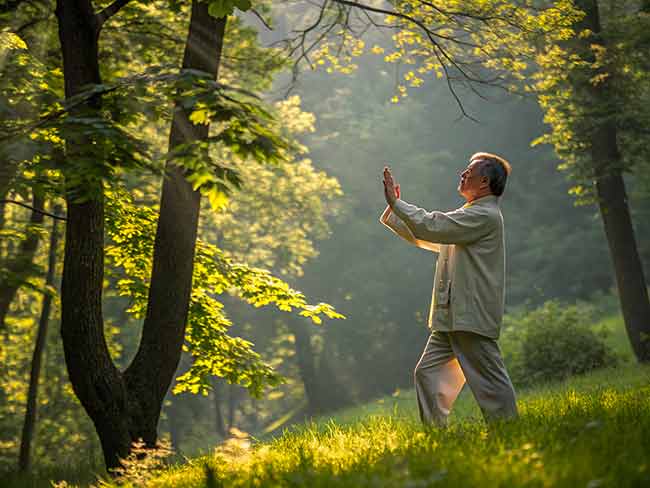
With the already mentioned Daily Flow! Exercises you will therefore also find some exercises that come from energy work.
In my opinion, shamanically inspired techniques are also part of these energy-based techniques – just like tapping (EFT, tapping techniques) or Qi Gong and Tai Chi, which originated in China.
Let me know if the topic of energy work is interesting for you, then I will be happy to write about it more often.
Result
In our Western world, we are used to looking at the world primarily on the material level.
This has enabled us to gain many scientific insights and technical advances that would not have been possible otherwise.
However, we should not forget that there are also other perspectives on the world. Other perspectives that are just as valid as our usual way of looking at the world.
And just as the rational mindset has its advantages and disadvantages, these other views also have their own advantages and disadvantages.
However, if we learn to consciously switch between the different points of view, we can give our lives new impulses and deal with difficulties more creatively.
The four levels of reality from the Huna philosophy offer a practical framework for this, which offers orientation and can help us to better classify even unusual experiences.
P.S.: Sorry that the article has become relatively long again. Actually, I didn't want to publish articles here for such a long time. But I find the Huna philosophy extremely helpful and exciting and it is always difficult for me to be brief. 🫣😉