
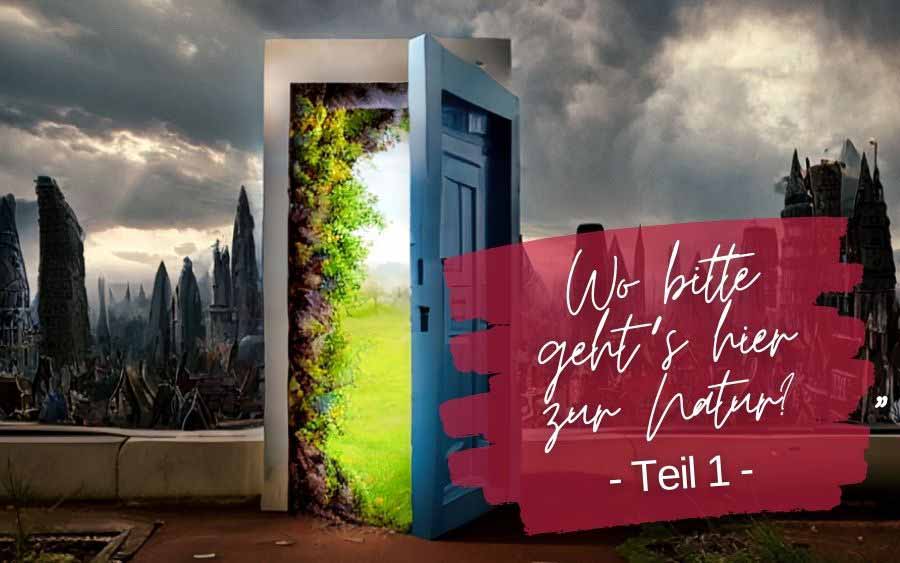
Here at Flowfeather, it's all about nature. About how you reconnect with the power and energy of nature. And about what positive effects such a connection on our health, our psyche and our overall well-being up to our spirituality - our place in the grand scheme of things - can have.
But what if there is hardly any nature left to connect with?
For example, many people who live in the city are faced with the problem. What options you have then, I have in in this article in more detail.
But what if the problem affects an entire country - for example, because there are hardly any original forests, wild rivers, or untouched coasts in a country - as is unfortunately the case in Germany?
How can you then deepen your connection to nature in order to go through life more inspired, relaxed and with more flow?
This is exactly what this and the following articles in this series of articles will be about.
In the first part you're reading right now, we'll look at what nature is and why I think we absolutely need primal nature around us to feel really good.
In the following parts, we will then look at the situation in Germany and how we can deepen our connection to "real" nature despite the pronounced cultural landscapes around us.
Let's start with the question of what nature actually is (and what it is not).
What is nature?
The question may sound a bit banal at first glance. Nature? It's clear that these are the forests, the rivers and of course the mountains. And the animals that live there.
All this is nature. What's the problem?
This or something similar could be used to answer the question. And that's exactly the view that most of us have on nature.
But is that actually true? Is the question of what nature is really so easy to answer?
Or is there perhaps more to it?
City, country, river - all nature, or what?
When we talk about nature, it often happens quite unconsciously out of the thought that on the one hand there are us humans and our civilization, and on the other hand nature.
We have to protect nature, because it somehow has its justification. And depending on how much we feel limited in our own needs by it, we are sometimes in favor of more nature conservation and sometimes less.
In my opinion, this view falls far short of the mark.
When I was still studying biology, I once read an essay by some biologists (unfortunately I can't remember the names) who held a view that seemed radical to me at the time:
The biologists wrote in this essay that the cities, skyscrapers, highway junctions and the concrete-covered parking lots in front of huge shopping malls, that all this is just as natural as the termite burrows of the termites in the African steppe or the castles of the beavers in North America.
I couldn't get used to the idea at the time. In the meantime, however, I see it differently.
From a biological point of view, humans are one mammal species among many.
Sure, we differ from other species in that we have a relatively strong ability to think (but new research suggests that many other species are also capable of quite extraordinary thinking skills).
Fundamentally, we are also "just" another species that has emerged over the course of evolution.
Did you know, for example, that up to 99% of our genes identical with those of chimpanzees?
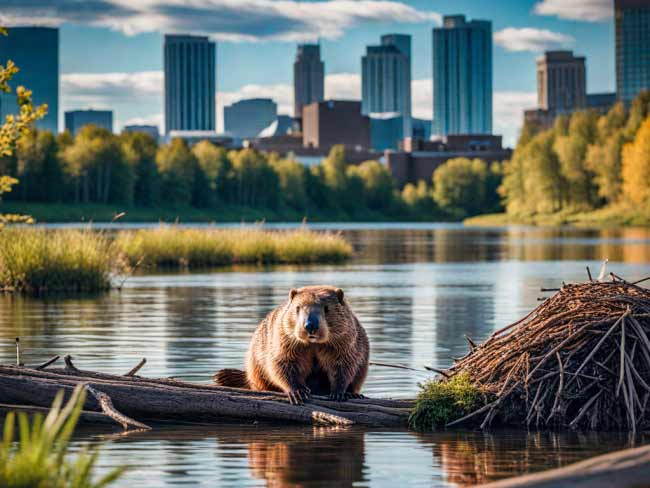
The dam of a beaver, the burrows of termites and the houses of men, all nature?
And with that, we are as much a part of nature as a lion, a rabbit, a tree, or the termites in Africa. And everything we build and produce is therefore also a part of nature - just like the dams of beavers or the structures of termites.
"And everything we build and produce is therefore also a part of nature - just like the dams of beavers or the structures of termites."
Sounds radical at first, because then we don't really have to worry about nature conservation anymore, after all, every motorway is somehow nature, isn't it?
In fact, the view that everything we build and produce, including ourselves, is a part of nature, is even the prerequisite for really being mindful and responsible with nature.
The Hawaiian Huna Philosophy By the way, Huna even goes one step further: Huna considers everything in this universe as nature, from the smallest atom in a drop of water in the ocean, to the needles of a giant sequoia, to the houses and streets of people, to the most distant galaxies.
All matter, all tangible things are an expression of an infinite, intelligent consciousness and are "nature" in the sense of this philosophy of life.
We are Nature
When we finally understand that we have nature are, and are not outside of nature, then hopefully we are more willing to protect nature.
Because protecting nature then also means protecting ourselves.
It means that we protect ourselves from the negative effects of our own actions.
"We are not sawing off the branch on which we sit. We are sawing off the branch that we are," says the biologist and philosopher Andreas Weber in in this post, which I had already quoted elsewhere.
Nature is so much bigger than us humans that it will always find a way to adapt to changing conditions. The only question is whether it will do this with or without us humans (unfortunately, our actions also affect thousands of other species that also suffer from it).
The same applies to climate protection, by the way.
The climate probably doesn't really care whether it's 2 or 3 degrees warmer. What we are protecting is not the climate, but our own livelihood.
To see the highways, skyscrapers and other human structures as part of nature and, above all, to see ourselves as part of nature, allows us to recognize these connections in the first place.
It lets us recognize that we are not viable without nature - because we are a part of it.
The two sides of nature
Nevertheless, we naturally speak of "nature" and I do not do otherwise here at Flowfeather.
How does that fit together?
To do this, we just have to interpret the concept of nature a little differently: Nature is not the counterpart to us humans, nature in this sense is simply the part of the whole of nature in which we humans exert little or no influence.
The "untouched nature", the wilderness - that's what many have in mind (myself included) when they think of countries and regions like Canada, Alaska, New Zealand, or Norway.
So there are two sides to nature:
On the one hand, the part in which the influence of us humans is clearly recognizable and then the area of nature, where we feel this influence only little or not at all.
Both are nature - and both sides are important for us.
Why cities and highways are important is probably immediately clear to most people. But why is the other part of nature - "untouched" nature - so important to us?
This is what the next sections will be about.
So, when I speak of "nature" below, I mean this untouched nature, the wilderness away from the influence of civilization.
Why we need nature
There are many reasons why we need nature. And I have already published a number of them on of this page described.
However, I would like to go beyond that here and describe some further aspects of why we need nature and should absolutely ensure that areas of untouched nature and wilderness are preserved or that their emergence is made possible again - especially here in highly industrialized Germany.
Nature as the basis of life
The ecological network, the interaction of the totality of all species in a habitat, also carries us humans.
Imagine that each animal and plant species represents a node in this network.
If a species becomes extinct or its population decreases dramatically, this node disappears into the network.
With two or three missing points, that's no problem. Probably not even if it concerns one or two hundred such nodes (judging by the size of this ecological network, it will probably still be able to fulfill its overall function somehow).
But what if thousands of these nodes in this network disappear - meaning thousands of species disappear because they no longer have a suitable habitat? At some point, the ecological network loses its load-bearing capacity - and can then no longer support us humans either.

"Humankind has not woven the web of life. We are but one thread within it. Whatever we do to the web, we do to ourselves. All things are bound together. All things connect."
Chief Seattle, 1854
"Mankind has not woven the web of life. We are but one thread within it. Whatever we do to the web, we do to ourselves. All things are connected. All things are tied together."
Chief Seattle, 1854
And we are approaching this situation: We are currently experiencing one of the largest species extinctions in history (not of our history, mind you, but of the history of the earth!).
Focus online reports in in this articlethat 1/5 of all species worldwide are threatened with extinction. In Europe, the researchers assume that almost 3000 species are threatened, worldwide they estimate the number at as many as two million species!
What effects this can have, can currently be seen for example in China watch. There, the farmers in Sichuan have to pollinate the fruit trees by hand with small brushes because there are no longer enough bees to do this job.
Interesting: Research have shown that fruits from plants pollinated by bees were larger, heavier and had a longer shelf life on average.
The NABU reports that 91 out of 107 crop species grown worldwide are dependent on insect pollination to varying degrees. Experts estimate that without pollination by insects, crop yields would decline by 90% (!).
Bees and other insects that pollinate our plants are therefore vital for our survival - in the truest sense of the word.
However, their survival (and thus ours) depends on a natural landscape that is at least somewhat intact. Conveying this knowledge is one of the tasks of the foundation "Germany is buzzing".
But the pollination of plants for food production is far from the only area in which it becomes clear how much we depend on intact ecosystems.
Other examples include:
- Overfishing of the oceans and decline of corals:
Both have led to a massive decline in fish stocks worldwide, on which we depend - directly as food and protein source or indirectly in the form of fishmeal, which is fed to our livestock (one could write a separate article about the sense and nonsense of this). - The supply of sufficient drinking water:
Many studies now prove the role of forests in the supply of drinking water. Forests not only have a filter function that ensures that our drinking water purifies itself again and again, they also play an extremely important role in the water cycle, as they evaporate an extremely large amount of water from the soil through the leaves and thus ensure sufficient rainfall. However, only intact forests can play this role. - Climate protection:
Forests also play a similarly important role in climate protection (which, as mentioned, is not about protecting the climate itself, but our livelihoods). Besides forests, it is primarily the oceans, and within them the green algae populations living in the oceans, that are enormously important for the climate - and which require intact and clean seas. - The extinction of adapted species in certain niches within ecosystems makes way for other species that can often transmit pathogens.
- The extinction of large carnivores such as wolves and bears in Central Europe has led to a sharp increase in roe deer and wild boar populations, which are hunted but have nevertheless spread to such an extent that they damage forests across the board and thus impair their function.
The last point in particular is a "hot topic" in Germany with the return of the wolves, i.e. a focal point.
When I was in the USA in the 1990s, wolves had just been reintroduced in Yellowstone National Park. At the time, I had an internship in the Wolf Park, Battle Ground who had scientifically supervised the reintroduction.
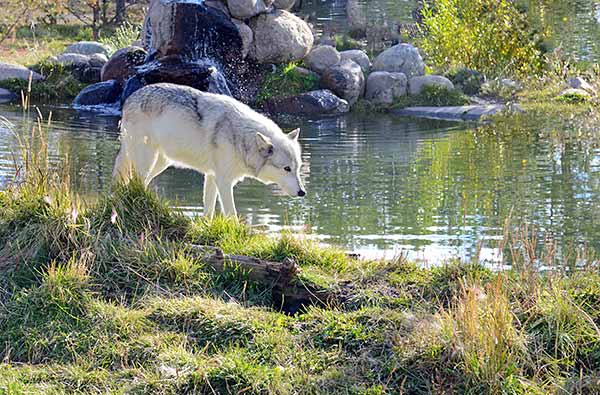
Wolf in Yellowstone National Park, USA
A few years after the reintroduction, the scientists noticed remarkable changes in Yellowstone National Park:
The deer, roe deer and elk, which had eaten the young trees along the rivers without the wolves, retreated deeper into the forests.
As a result, the riparian vegetation grew. This provided nesting opportunities for birds that returned to the rivers.
At the same time, the growing trees provided new habitat for beavers, which also returned to the park.
The beavers built dams that changed the course of the rivers and created stagnant waters.
Due to the reduced flow velocity, new fish species settled. The stagnant waters with their many micro-habitats and increased soil moisture also led to an increase in plant species in the shore areas.
These formed the food basis for pollinating insects, which in turn contributed to the fact that the river banks shone in all colours as pollinators of a large number of flowering plants.
In addition, the return of wolves had a variety of other positive effects (there is an interesting article on this by Spektrum der Wissenschaft as pdf-Download). Perhaps also an argument for seeing the return of wolves in Germany with different eyes?
Result:
Nature is not just a backdrop for beautiful weekend hikes. Nature is essential for our survival, we need nature. Especially original, "wild" nature is extremely important, as it serves as a "buffer" to protect species and ecosystems from the negative consequences of human actions.
Nature and health
Many studies now prove the positive effects of nature on us humans. Forest bathing (Shinrin-yoku) was even "invented" in the 1980s by the then Japanese Ministry of Health as a measure for health prophylaxis precisely for this reason.
For example, various studies have shown that forest bathing can have a positive effect on blood pressure, lower the concentration of stress hormones in the blood and activate the immune system (on this page I have told you some of the studies linked).
One Research Paper from 2021 discusses the current state of research and concludes that contact with nature can have a positive effect not only on physical health, but also on mental health.
For example, in studies, spending time in nature not only improved general well-being, but also reduced feelings of anxiety and symptoms of depression (if you suffer from this, please be sure to seek professional support!).
In addition, it was shown that spending time in the countryside can also improve cognitive performance. Study participants report that after spending time in nature, their attention span increased and they were able to concentrate better.
The extent to which a natural environment can have a positive effect on humans is also shown by a Study, in which two Swedish kindergartens were compared with each other.
One of the kindergartens was located in an urban environment, the other in a small village outside the city and offered the children access to relatively unspoilt nature.
The children in the kindergarten with the natural environment performed better than the children in the urban kindergarten in all the parameters studied.
But not only forests and green nature (the so-called "Green Spaces") have a positive effect on our health.
Also, "Blue Spaces" - coastal landscapes and water-rich areas such as lake and river landscapes - have demonstrably positive health effects. A large-scale Meta-study (these are studies that summarize and evaluate a number of other studies) also from 2021 comes to the conclusion that larger bodies of water help people to be more relaxed and feel less stress.
Both - the Green Spaces and the Blue Spaces - demonstrably contribute to people's well-being and health.
There seem to be four things in particular that are responsible for this effect:
The encounter with animals, the stay by the water, the opportunity to look into the distance and hiking on landscaped paths through nature.
At least that's what the Result of a study from 2020, which was held at Discovery Park in Seattle, USA.
Especially the latter - hiking on paths through nature - can have a dramatic effect on the perception of nature.
Here is an example from my own experience:
Near my current place of residence, there is a forest sports trail - that's the official designation. The paths are not forest roads, but specially constructed trails.
The floor is soft and natural to the touch. There are roots and moss and sometimes the path becomes very narrow, so you can walk very close under the trees.
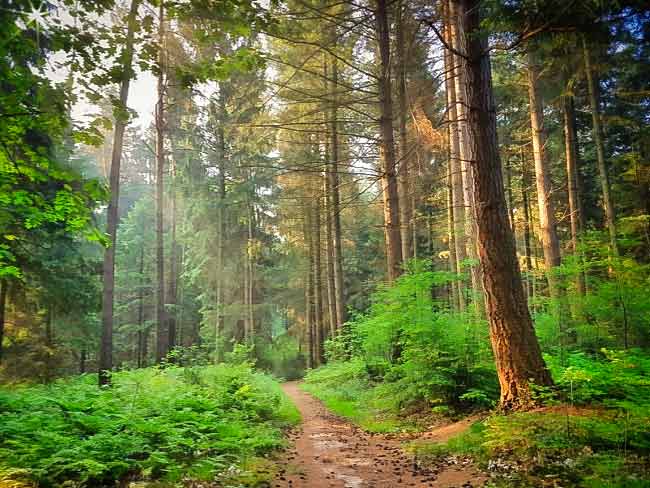
Created path in the forest sports trail
Walking through the forest on such paths is something completely different from hiking through the forest on the large forest paths!
Summarized:
Access to original nature can help people to feel good and stay healthy in the long term. The more original and "wild" nature is, the greater this effect.
Another point that underlines the importance of untouched nature for us humans.
Nature as a place of retreat
Besides the "hard facts" - the scientifically confirmed effects of nature on our health and well-being and the ecological importance of nature for us humans - there are also completely different levels on which nature represents a valuable resource for us.
For example, as a retreat from modern and all too often exhausting civilization.
Why is this important?
Earlier, I had made the distinction between the part of nature where human influence is noticeable and the part where it is not (the "untouched" nature).
As long as we stay in the former, we quickly succumb to the influence of the people around us.
People who are very skilled in meditation may be able to escape this influence quite well and maintain a good connection to their inner self despite the many distractions around them.
For people who are not, on the other hand, this is much more difficult.
All too quickly, you are influenced by the world around you more than you might want to admit.
Constant noise, the permanent drizzle of advertising, thousands of pieces of information constantly bombarding us - it makes it difficult for us to perceive our own needs and our own inner voice.
Anyone who immerses themselves in the peaceful atmosphere of a forest from such an environment often has the feeling of entering a completely different world.
Suddenly it is there, the Connection to one's own inner self, to the voice of the heart and intuition.
And questions that you have been pondering for hours before seem to dissolve almost by themselves. Simply because you suddenly see everything much more clearly.
"Look deep into nature, and then you will understand everything better." - Albert Einstein
In untouched nature we have access to ourselves, precisely because the influence of other people is low or even non-existent.
That's why it's so important for us to spend time in nature at regular intervals.
Even Men's Health magazine - not exactly known for a meditative and spiritual view of life - recommends in an article for this, the 20-3-5 rule:
20 minutes in nature three days a week, 5 hours in total per month, and additionally three consecutive days spent in nature each year - this is the recipe to escape stress and live healthier.
The 20-3-5 rule by psychologist Rachel Hopman from the University of Utah in the USA is also known (and researched) as the "Nature Pyramid".
Nature and Spirituality
If we want to look at the role nature plays in our spirituality, then we should first think about what spirituality actually is.
This is actually a big question that everyone has to find an answer to for themselves (if they want to) and that cannot be answered in a blog paragraph.
It can't really be answered in a complete blog article. Nevertheless, there will soon be a separate article by me that deals with this question.
Here I just want to share a few ideas and suggestions with you, so that you know how I feel about the topic and you can better understand my thoughts.
After all, the topic of spirituality comes up again and again here at Flowfeather.
What is spirituality anyway?
If you are interested in spiritual topics and have perhaps already done a Google search or two, for example for books on such topics, then thanks to the Google algorithm, you will probably often be presented with advertisements for tarot card readings, horoscopes, law-of-attraction webinars or angel seminars.
These are all topics that we somehow associate with spirituality. And where we sometimes ask ourselves what of it is actually real and what was only written because it sells well.
The question of what spirituality actually means at its core also usually remains unanswered.
Let's look at the word itself. Spirituality comes from the Latin "spiritus", which according to the PONS dictionary means something like "draft, wind, breath", but also "breath of life, soul, spirit".
This comes close to the meaning of the English "Spirit" - a word that I like to use here at Flowfeather because it is less loaded with meaning than our German word "Seele" (soul) - for the spirit or soul of something.
To be "spiritual" therefore simply means, first of all, that one is of the opinion that there is such a thing as a spiritual world.
It is the belief that the world is not just a random pile of matter, but that behind this material world lies a spiritual world that influences matter.
And more: A spiritual view of life assumes that the entire material world is an expression of an infinite, intelligent consciousness.
Whether one follows this thought is ultimately a personal decision. And with that, spirituality and "being spiritual" are also a decision that everyone makes for themselves, very personally.
Because:
Such an infinite, intelligent consciousness cannot be proven - even if there are many arguments in favor of it (more on this in the aforementioned own article on the topic of spirituality).
If one opts for this perspective, the question naturally arises as to how to "live spiritually", how to integrate spirituality into one's own life - without chasing every esoteric hype.
And that's where nature comes into play.
With nature to more spirituality in life
Just going out into nature brings us more into contact with our spirituality. For nature is a direct expression of life, i.e. of the creative spirit behind the material world.
When we are in nature, we feel the energy of this intelligent consciousness - whether you call it God, the Divine, the Universe, Great Spirit, or simply the Source of Life.
And the "wilder" and more original nature is, the easier it is for us to get in touch with this energy (the "good vibes" of nature).
Because in the original nature the influence of humans is not or hardly noticeable (remember the paragraph about what nature is) and our perception is not constantly distracted.
In nature, we are automatically more in feeling and less in thinking. And this is the prerequisite for spiritual experiences.
This is also the reason why people in all cultures, in their search for knowledge and a spiritual way of life, have often retreated into nature - be it the Zen monks in Japan, the monks of the Christian tradition in Europe, or the Native Americans during their vision quest, to name just a few.
All of them have withdrawn into nature, because that's where we come into contact with the source of life most easily.
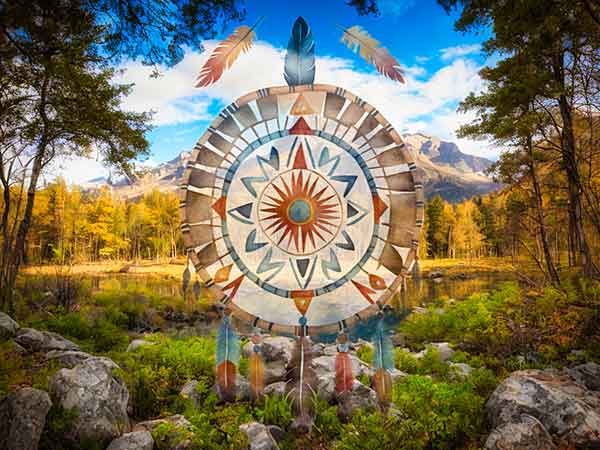
In nature we have easier access to our spirituality
We feel the awe of life and the source of life - and spirituality thus automatically becomes a part of our lives.
And if you like, you can go even further:
Talk to the plants and animals as you walk through a forest, for example. And watch what that does to you. How this kind of encounter with nature changes your own inner self.
Often people who try this feel an emotion or energy wave running through the body after they have addressed the spirit of a tree, for example, in their thoughts or out loud.
After Serge King and the Huna Philosophy This is a response from the spirits that we perceive in this way.
This may be a very unusual thought for many at first, but in the end everything is energy and energy interacts with each other.
From Nikola Tesla, the brilliant and controversial physicist and engineer after whom Elon Musk named his company Tesla, the following quote has been handed down:
"If you want to understand the universe, think in terms of energy, frequency, and vibration." (Nikola Tesla)
Even though spirituality always remains a personal choice, the assumption that the world around us is just a random collection of lifeless clumps of matter is, in my eyes, an outdated view that has its roots in 17th and 18th century physics and is hardly compatible with a modern worldview.
I believe that we should get away from such a mechanistic worldview, which is not good for us or the world around us.
And the regular stay in unspoilt nature is a good and important first step in this direction.
Conclusion Part 1
The first part of the article series "Where is the way to nature?" dealt with what nature actually is and why it is of central importance to us humans.
We have seen that there are two sides to nature and that we humans are both part of nature and dependent on it.
We looked at the many positive effects of nature on our health and well-being and addressed the importance of nature for everyday spirituality.
And we have seen that all these positive aspects of nature become all the more apparent the more original and "wild" nature is.
And that brings me to the second (and third) part of the series, which will be about what the situation is actually like here in Germany.
Is there still any wilderness and original nature in Germany? What opportunities do we have to bring more nature into our own lives and to feel the energy of this "wild" and original nature if we don't have (any more) rivers, mountains, and primeval forests on our doorstep?
These are questions that will be addressed in the next article.