
Here at Flowfeather, it's also about how you can increase your resilience and better deal with the stress and challenges of life by connecting more with nature.
Important building blocks for this are inner peace and serenity.
In this article, you'll learn what the difference between the two is and why inner peace is one of the most important resources for a resilient life.
I'll also show you an exercise that will help you get back to your inner peace very quickly when things get stressful and exhausting.
What exactly is inner peace?
What exactly your own inner peace actually is can be determined quite well by how we feel when it is missing in our lives.
Then we feel tossed back and forth by the situations of everyday life, are hectic, tense, stressed and usually quite irritable.
In such moments, we lose the sense of the beautiful things in life, which still exist, and are usually only focused on the problem that has upset us so much.
And yes, I feel the same way often enough.
Often in such a situation, we also say something like: "That just drags me down."
And that actually sums up the matter pretty well, because our energy level also drops and is literally pulled down when we lose our inner peace.
So what exactly is meant by "inner peace"?
It is a state in which we are calm and serene inside and in our center. Tension and relaxation are in balance. You could say that we are present in the present moment with relaxed attention.
The energy can flow freely and unhindered (more on that in a moment) and we can feel the power inside us. Because the energy can flow freely, we are in flow with ourselves and with the situations we encounter.
As a result, we make the right decisions at the right time and things just work better.
In Taoism, an ancient Chinese wisdom teaching, this attitude is called "Wei Wu Wei" (often also simply "Wu Wei"). This is often translated as "acting by not acting", but the actual meaning is more like "acting by acting correctly".
Do the right things at the right time in the right place. This becomes possible when we are in our inner peace.
The lake in the moonlight
In many martial arts, the metaphor of the lake in the moonlight is used to describe this state of inner calm.
At dusk there is a lake that is illuminated by the light of the full moon. When the lake is choppy and churning, we only see the waves on the surface of the water.
Only when the lake becomes completely still and the water surface is completely smooth, i.e. when the lake is completely calm, do we see the reflection of the moon on the water surface.
Any change in moonlight is immediately reflected by the still water.
Transferred to our lives:
When we are in a state of inner peace, we react spontaneously and intuitively to every situation appropriately and purposefully, so that we always achieve the best possible result.
Why do we need more inner peace in our lives?
Our modern society is characterized by restlessness and permanent activity. "New York - The City That Never Sleeps" is even the title of a documentary with Kim Cattrall. And what is true for New York is just as true for many other cities.
Many years ago, I once read a very interesting book by the physicist Hans-Peter Dürr. The book was the summary of a congress called Geist & Natur, which took place in Hanover in 1988.
In the book and at the congress, it was discussed, among other things, how much our Western society is characterized by rationality, logical thinking, and external action, while in Eastern culture, introspection, intuition, and meditation play a more important role - all things that are closely connected with the concept of inner peace.
You may also be familiar with the Chinese symbol for Yin and Yang, the two basic energy qualities of life. The idea of Yin and Yang comes from Taoism and fascinated me so much as a teenager that I even painted the symbol large on the back of my jacket.
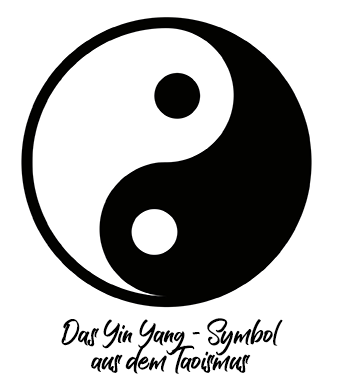
Yin is the silent, passive, receptive energy, while Yang stands for the active energy, the giving and outward-directed. In both energies, the other is already inherent, which is symbolized by the small "eyes" in the symbol.
Yin and Yang, the passive and the active side, are in a dynamic balance according to the teachings of Taoism. Sometimes one predominates, sometimes the other predominates - symbolized by the curved lines.
When both energies are in balance in this way, they complement each other to form a unit (the circular shape of the symbol). If one side or the other permanently predominates, we lose our balance - we lose our inner peace.
Then things just don't run smoothly in our lives anymore (the circular shape of the Yin Yang symbol fits very well with this!).
In my eyes, the yin-yang symbol expresses very nicely what resilience means: Of course, there are phases in life that are very exhausting and associated with a lot of stress. And there are phases in which we tend to be passive and withdraw.
If the change between these phases of life is natural and dynamic, we quickly return to our center (inner peace) after such phases. And that's exactly what the term resilience means.
However, the Yang side, i.e., doing and making, usually predominates in our lives. Quickly check emails here, send a WhatsApp message briefly there, and then briefly consider what needs to be done for the next day – Yin and Yang have fallen out of balance.
To put it in a more modern way: stress and strain have become our normal state.
We put the active side (the yang, if you want to call it that) so much in the foreground that we can hardly calm down, go through life restlessly, feel more and more uncomfortable and then want to distract ourselves from it with even more activity.
This not only throws us out of balance, but the whole planet Earth.
Therefore, it is not only very important for us to find our inner peace again, but it is important in order to keep our Earth as the unique place that it is "by nature".
And in nature, we actually come back to inner peace very quickly. Because there we are more in the Yin energy, the passive, receptive energy.
We walk through nature and look, feel, receive - and this creates a balance to the often overemphasized yang energy in our lives.
In this way, we create a balance by spending time in nature and come back to our inner center, can leave stress and tension behind us and find our way back into the flow.
Inner peace vs. outer peace
One Study The Techniker Krankenkasse shows that 30% of the people surveyed suffered from sleep disorders. The most common cause: stress.
People suffering from sleep disorders wake up in the morning tired, tense, and not very rested – if they have slept at all.
For one's own regeneration, it is not enough to just become calm on the outside. Lying down and closing your eyes while your thoughts continue to deal with all the problems of everyday life.
We also need to calm down internally so that we can really regenerate.
Inner peace is therefore also the key to deep regeneration - you remember, tension and relaxation are in balance when we are in our inner peace. And that is something that is often lacking in today's world.
But often enough, the external peace is also not present in our society and in our lifestyle. Loud music, traffic and airplane noise, mobile phone use, television to fall asleep - all these are factors that do not let us rest even externally.
A first step towards more inner peace is therefore to regularly ensure that we find peace in our external surroundings. For example, by leaving the TV off, putting the mobile phone aside, or - and this is the best option - by regularly going out into nature.
The difference between inner peace and serenity
In fact, we usually use the two terms synonymously. For me, both terms are similar, but not the same.
In my eyes, serenity has more to do with our mental attitude. I'm relaxed when I accept things as they are right now and my thoughts don't constantly revolve around the things that aren't going the way I want them to.
Inner peace, on the other hand, goes even deeper.
If I am calm inside, then I am in my center. Body, mind and soul are in harmony and my life is in balance.
In Japan, there is the concept of "Hara" for that.
"Hara" - we are sticking with this name - is understood by the Japanese as the possession of that total constitution of a human being which enables him to open himself to the forces and the unity of original life and at the same time to bear witness to them in the mastery, meaningfulness, and fulfillment of his life." - Karlfriedrich Graf Dürckheim
Inner peace therefore goes far beyond simple serenity. One could perhaps say that serenity is a characteristic and a prerequisite for inner peace.
Inner peace, on the other hand, means more of a basic feeling and also an attitude towards life as a whole. An attitude that reconnects us with life and ensures that we are in flow with ourselves and our lives.
The power of inner peace
Just now I spoke of Yin and Yang - the two fundamental energy qualities of life from Taoism.
This concept of a universal life energy exists in many ancient cultures. In India as "Prana", in China as "Qi" or "Chi", in Japan as "Ki", in Hawaii also as "Ki", among the Greeks as "Pneuma" and among the Romans as "Spiritus" - to name but a few. Our word spirituality derives from the latter.
From my point of view, an idea that has emerged in so many cultures - sometimes independently of each other - very likely has a practical benefit.
Otherwise, it simply would not have prevailed.
In fact, I believe that this life energy plays a central role in our lives and that the concept behind it can help us to live more relaxed, better and more fulfilled.
In this view of the world, stress and tension always arise when our life energy is blocked. This happens when we build up an inner resistance to the things that are happening in our lives right now.
This resistance – our thoughts and attitudes towards things – creates friction and causes life energy to stagnate. And we perceive this as stress and tension.
Of course, it is completely up to you to what extent you adopt this idea for yourself.
But I can say from my own experience that this view of the problems in our lives is quite helpful, because it allows us to work directly with the energy behind the stress and thus not "manage away" the stress, but dissolve it directly at the root.
For me, "finding inner peace" is therefore also a path that is about bringing one's own energies back into harmony and balance.
Then we feel connected to life, have enough energy to implement our plans, have access to our intuition, make the right decisions more easily and sharpen our focus on what is really important to us in life.
Inner peace in this sense is therefore much more than simply being "calm inside". When we are at peace with ourselves, we have the strength to shape our lives actively and consciously.
Inner peace and health
All cultures that are familiar with the concept of life energy do not consider health to be simply the absence of disease. In these cultures, health is the state I described above: the coherent, free flow of life energy.
You are probably familiar with acupuncture from Traditional Chinese Medicine (TCM). Anyone who has ever undergone such a treatment can confirm how effective acupuncture can be.
In Japan, they know Shiatzu massage - a form of massage that is now also offered in many cities in Germany.
Both - acupuncture and Shiatzu - aim to bring life energy back into flow. Behind both is the idea that we are healthy when our life energy can flow freely.
Also Qi Gong or Tai Chi - movement meditations from China and Japan respectively - also work with life energy. Just like Pranayama, the breathing meditation from Yoga and the martial art Aikido (Ai = harmony, Ki = energy, Do = away).
If you follow this concept, then inner peace is an important building block for a healthy life, because it ensures that energy can flow freely.
Resilience - Finding your inner center
Becoming more resilient in life is one of the topics that Flowfeather is all about. And increased resilience is also another benefit of inner peace.
In psychology, resilience refers to the ability to swing back to our center when confronted with stress in our lives.
The better we succeed in this, the better we can deal with such stress-inducing situations.
Psychology knows a number of so-called resilience factors (the 7 pillars of resilience), which have an impact on how resilient we are.
However, if we are not in our center before the stress, we can't swing back to it, of course.
This is exactly what I once felt very intensely when, at the end of my studies, several stress-inducing situations met in a short time.
If, on the other hand, we create the conditions for more inner peace in our lives, we are automatically more centered and thus also develop a higher level of resilience.
Being in one's own inner center thus becomes the normal state. If a situation then upsets us for a short time, we quickly and automatically swing back into our inner center and come back into balance.
In this way, inner peace helps us to better deal with the stress and stressful situations in our lives.
What happens when we lose our inner peace?
When things upset us or when we go through life restlessly (without resting), we lose our inner peace.
But that doesn't mean that we should rest all day so as not to lose inner peace.
Life is change and movement. It is an alternation of tension and relaxation, just like a wave with a wave crest and a wave trough.
It becomes problematic when one of the two sides in our lives permanently gets out of hand.
For example, if we work too much, think too much about a problem and start brooding, are constantly available or are on our cell phones and are always stressed.
In short, when we don't take the time to regenerate sufficiently.
Then we are tense, erratic, hectic, restless (in the truest sense of the word), make the wrong decisions and lose sight of what actually counts in life.
But also when the other side gets out of hand, i.e. when we are not active enough, let ourselves down, do nothing more and spend most of the day on the sofa, we come out of our inner peace.
We then feel limp, energyless and tired, can hardly bring ourselves to do anything and lose interest in many things that we may have even liked to do once.
Inner peace means that tension and relaxation are in balance in our lives. Then we are back in our center and have the feeling that our life is in balance.
Regain inner peace - practical exercise to join in
Here I have a little exercise for you from NLP, with which you can quickly find your peace again at any time. Of course, such techniques and formats can only ever serve as short-term help.
Mastering everyday situations with inner peace is a (learning) process that is about changing one's attitude as a whole and that is not finished with one or two small formats.
How you can achieve this, you will find many ideas and suggestions here at Flowfeather.
But now to the promised exercise.
Close your eyes and think about the situation that is upsetting you right now.
Feel into your body, where you can physically perceive the restlessness. This can be a feeling of pressure in the stomach, a pulling sensation in the chest area, pressure on the shoulders or anything else.
Describe exactly how this body perception feels to you.
And now think about the direction in which this body perception seems to be moving. If you can't think of a direction, just think about which direction you would choose if you had to set a direction.
Now the exciting part:
Make this movement of your body perception slower and slower in your mind. Until the body perception has come to a complete standstill.
Do you have it?
Then try now to see if you can even reverse the direction of your body perception. For example, if it has previously moved from the outside to the inside, try to see if you can imagine how it moves from the inside to the outside.
Hold this idea in your consciousness for a few seconds and let the feeling spread.
Take another deep breath in and out and then open your eyes.
That's it.
Through this exercise you have set a new stimulus and shown your subconscious a new way to look at the situation that has upset you so far. From the point of view of the concept of energy, one would say that you have set a new energetic impulse.
No matter which explanation you choose, observe how your feeling about the situation changes over the next few hours.
You will most likely find that the situation no longer upsets you so much and that you have regained your inner peace to a good extent through the exercise.
Of course, you can also repeat the exercise at any time!
Write me your experiences with the exercise in the comment field below. I'm looking forward to your feedback!