
As co-namer of this website, the term "flow" naturally deserves to be examined a little more closely in one of the first contributions 🙂 .
If you want to know what the rest of the headline for this article ("Everything is in flux") is all about, then feel free to read my Manifest through. There I also describe how it goes to the second part of the name of my website (FlowFeather).
Flow in psychology
In psychology and beyond, the term flow has been developed through the work of the psychologist and happiness researcher Mihály Csíkszentmihályi became known. Csíkszentmihályi devoted much of his work to researching the Flow He also dealt in detail with the question of what these conditions must look like for people to experience such flow feelings.
What is flow anyway?
People who experience flow while performing an activity are fully focused on the task they are doing. They are completely absorbed in the activity, there are no wandering thoughts and no doubts about having the necessary skills for the activity performed. The sense of time changes, you forget space and time and are completely in the here and now.
When people are so absorbed in an activity, it can lead to experiencing intense feelings of happiness - the actual flow experience.
Many athletes know this feeling of happiness from their own experience, because flow often occurs during sporting activity. And indeed, many of the test subjects with whom Csíkszentmihályi has worked in the study of the flow state, extreme athlete.
Csikszentmihalyi found in his research various criteria that must be met for flow to occur. However, flow states - which are also often referred to in English-speaking countries as "being in the zone" - do not force it. You can only create favorable conditions for flow.
How flow can be created
What do these framework conditions look like now? How does an activity have to be designed so that flow can be experienced when performing the activity?
After Csíkszentmihályi, an activity must meet the following conditions for flow to occur:
- You have to be completely absorbed in an activity and completely focused on the performance of the activity.
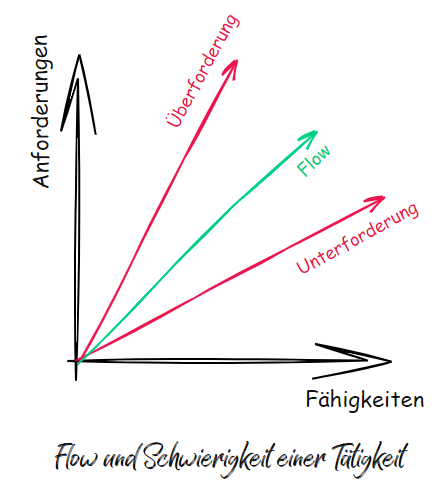
- The demands that the activity brings must be neither too high nor too low - neither overstrain nor boredom should arise.
- The activity must include clear feedback, one must be able to perceive the success of the action.
In his work, Csíkszentmihályi repeatedly emphasizes the importance of the second point. In order to be able to experience flow, the task must not lead to an underchallenge, nor to an excessive demand:
Although Csíkszentmihályi, as a representative of the Positive Psychology popularized the term flow, he was not the first to deal with the description of the special emotional states associated with the feeling of flow.
Flow in Game Science
Especially in studies on people's gaming behavior, the feeling of flow appears even before Csíkszentmihályi. There, the complete absorption in the game and the forgetting of time is characteristic of playing.
Interestingly, a quote has already been handed down from Friedirch Schiller that emphasizes the importance of playing (and thus the feeling of flow) for being human.
"Man only plays where he is a human being in the full sense of the word, and he is only fully human where he plays," - Friedrich Schiller
And the Bible already says that man must become like children if he wants to enter the kingdom of heaven.
And what do children like to do most?
That's right, play!
Flow is more
So far, we have mainly dealt with the feeling of flow described by Csíkszentmihályi in psychology.
However, I see the term flow a little more broadly and that's exactly what I'm going to talk about in the following.
So keep in mind that it's no longer about scientifically proven information, but rather about personal experiences and my personal view on the topic of flow.
I had just mentioned the quote from Friedrich Schiller and the saying in the Bible about the meaning of being a child.
My Opinion:
Both show that to be in the flow, is essential for us humans and is the prerequisite for leading a happy and fulfilled life.
And therefore I also do not believe that the feeling of flow is limited to activities that - as Csíkszentmihályi described - have certain prerequisites. It is simply easier for us to experience flow in such activities.
But we can also learn to be more in flow in our lives overall, for example, by consciously concentrating on the things we are currently doing - that is precisely the approach of mindfulness teaching.
And this brings us back to the topic of inner peace.
If I learn to stay calm and live from the inner center, I am automatically more in the flow. With life, with myself and with everything that is around me.
And one of the best ways to get into a state of inner peace is to stay in nature. That's why we usually have the feeling of being in the flow very quickly.
What actually flows in the flow?
"Flow" is English for "to flow". And that naturally raises the question of what is actually flowing.
This is where the concept of a universal life energy can help, an idea that can be found in many cultures and which I have already discussed in in this article had written something.
I believe that it is this life energy that "flows" when we are in the "flow". Flow in this sense is an expression that our life energy can flow freely and unimpeded.
And this is - from my point of view - the state that Friedrich Schiller described in his quote: Then we are "fully human". Incidentally, in NLP this state is called Core State, there will be a separate article about this later.
Important: The cultures that know and use the concept of life energy assume that the free flow of life energy is the prerequisite for health, happiness, contentment and prosperity.
So all things that one can associate with "being fully human".
Emotion = Energy in Motion
From the very well-known and successful American coach and author Anthony Robbins comes another quote that fits well into this context:
"Emotion = Energy in Motion." - Anthony Robbins
Our emotions and feelings are the driving forces behind our actions. They make us do certain things and leave others.
And they are very closely related to our life energy.
Emotions must therefore be able to flow freely. If they can't, for example because we reject certain emotions in us, inner blockages occur and the life energy comes to a standstill.
This, in turn, causes a variety of problems in all kinds of areas of our lives.
A concrete example:
There was a time in my life when I was very angry with someone who I thought had wronged me.
However, I found the emotion behind it to be negative. That's why I felt guilty about the anger inside me, which made the situation even worse.
The anger became stronger and stronger (because it was blocked), the feelings of guilt as well, and in the end I was completely beside myself and didn't know what to do.
It would have been better back then to first accept the feeling of anger and then channel the anger (appropriately) - for example, by seeking out the conversation with the person concerned and setting clear boundaries.
Because that is the task of anger: it indicates to us when our boundaries are violated and provides the motivation to set boundaries.
Inner peace does not mean being emotionless
Those who are at peace with themselves do not have to accept everything that happens without emotion. Inner peace does not mean being rigid and motionless inside.
Of course, once I've learned to rest in myself, things in my life don't throw me off track so quickly. I can deal with challenges and stress in my life better, I am more resilient and simply have better access to my resources.
I will then experience fewer unpleasant emotions. Emotions such as anger, worry or grief will not disappear completely.
That would not be desirable at all, because every emotion fulfills a function.
Inner peace therefore also means accepting emotions as they arise and letting the energy behind them flow freely - even when the emotions are unpleasant (I prefer to use the term unpleasant emotions instead of negative emotions).
Then I can make sure that I express and channel the emotions in an appropriate way so that they can fulfill their function. When I deal with my emotions and feelings in this way, they usually dissolve very quickly.
This way I stay in the flow even when things don't go the way I want them to.
Flow and intuition
Our intuition, i.e. our gut feeling, is probably one of the most underestimated abilities we possess. We are used to rationally justifying decisions and try to carefully weigh up the pros and cons before making important decisions.
The advertising industry, for example, knows very well that the decision-making process usually takes place exactly the other way around: First we decide (usually unconsciously) on the basis of our gut feeling for one or the other variant, then our rational mind looks for logical arguments that justify this decision.
Of course, real intuition goes far beyond gut feeling when shopping. True intuition allows us to instinctively grasp which decision is the right one for our lives and what we should do in the current situation.
And:
Intuition always expresses itself through our body sensation. Because it is located in the subconscious - our body intelligence - and therefore needs our body as a "mouthpiece".
When our intuition speaks to us, something simply feels "right" somehow. It is somehow "round" and causes a pleasant, light feeling.
But if we mentally toss and turn our problems back and forth all day, worry about the deadline the day after tomorrow and everything grows over our heads, we usually forget that we have a body at all.
No wonder that we don't have access to our inution in such moments.
If, on the other hand, I am at peace with myself and in my inner center, I am automatically connected to my body and thus also to my subconscious as a source of intuition.
Then I also feel very clearly what my intuition wants to tell me and can decide accordingly.
Afterwards, there is still enough time to question these decisions rationally.
We have particularly good access to our intuition in nature, because then we are automatically more centered and have a better connection to our body feeling.
For example, Ludwig van Beethoven is reported to have gone for a walk in the woods in and around Vienna every morning to promote his creativity and get new ideas for his music.
And people all over the world have always sought to stay in nature in search of enlightenment and divine insights.
The River of Life
That I Ching, an old Chinese book of wisdom, describes in 64 so-called hexagrams various "weather situations" of what could be called the "flow of life".
The idea behind it:
There is such a thing as a natural order of things. What is meant by this is that the universe as a whole does not develop chaotically here and there, but that it develops in a certain direction.
Of course, the question arises in which direction.
The answer to this question, which we find for ourselves personally, has a significant influence on how we live.
Or as Albert Einstein puts it:
"The most important decision we make is whether we believe we live in a friendly or hostile universe." - Albert Einstein
In the old Hawaiian knowledge of life, Huna Philosophy It is assumed that everything in the universe is evolving towards a state of greater harmony. In this view, the universe is permeated by the Aloha spirit.
Aloha, the "joyful sharing of breath in the presence" - translated a bit more freely as "love" - is the basis of everything in the universe and everything strives towards this love.
If you subscribe to the idea that the development of the universe knows a direction, then it makes sense to know this development and to take it into account in your decisions.
To go with the flow and not go against the flow of energy in the universe.
When we are "in flow" with our decisions and when not, our intuition tells us. If it feels "coherent", our decision follows what naturally wants to develop.
And I perceive this best when I am at peace with myself and in my inner center.
To live out of inner peace therefore also means to come back into harmony with the universe as a whole and the natural development of things.
So it doesn't matter?
However, this does not fit at all with what we usually live in our society. "Whoever wants to reach the source must swim against the current" is a saying that accompanied me intensely in my youth.
So, should I accept everything that is currently happening in the world and should I lean back because everything is following its "natural development" anyway?
No.
I believe that not everything follows its natural development at the moment. With our way of thinking and living, which is oriented towards resistance and confrontation, we have ensured that there is a lot of turbulence and blockages in this natural flow of life.
Both in the small, everyday things that affect us personally, and in the big things that affect our planet as a whole.
The Film "Koyaanisqatsi" by Godfrey Reggio from 1982. On the Page "Reconnect" you can find a small trailer for it.
So there is plenty to do, even and especially if I want to follow the "natural flow of life".
Result
Flow is more than the feeling of happiness that occurs when you are completely immersed in certain activities and forget about time and space around you.
Flow arises from a basic attitude towards life, which leads to the fact that you are connected to the life energy and that it can flow freely in and through you.
Those who are in flow with life in this way are connected to their innermost core, rest in themselves, have access to their intuition and follow the natural rhythm of life.
In this sense, flow is an expression of a deep, inner wisdom about life and the prerequisite for happiness, joie de vivre and a fulfilled life.