
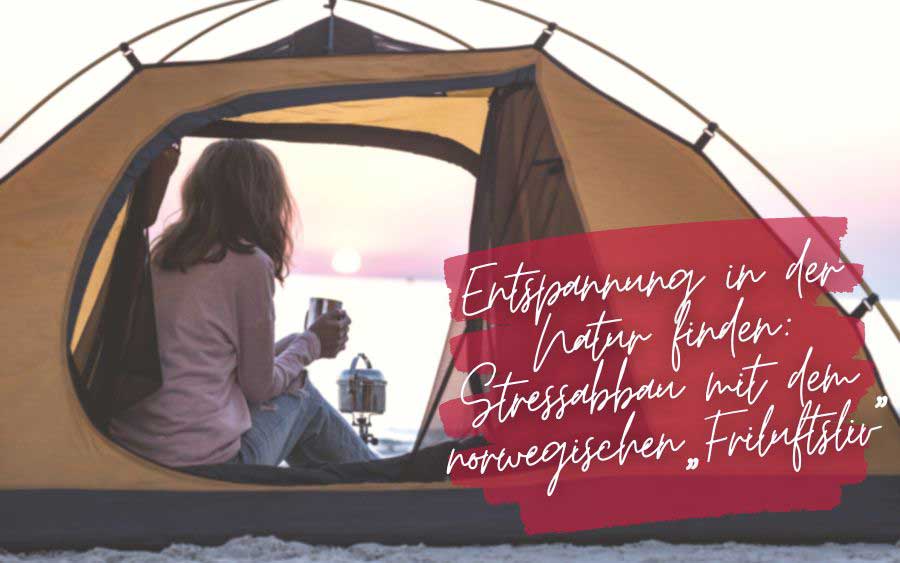
"Finding relaxation in nature" is the topic of the last post from my Scandinavia Series. And at the same time, it is also one of the main reasons why more and more people are drawn out into nature. Whether it's for a weekend getaway or a well-deserved annual vacation, nature offers a wonderful way to relax, rebalance your body and soul, and recharge your batteries.
The Norwegians have known this for a very long time and have firmly anchored this insight in Norwegian culture with their "Friluftsliv".
Friluftsliv: The Norwegian idea for more relaxation in nature
"Friluftsliv" - literally translated "open-air living", meaning life and staying in the forest and in the great outdoors - is a Norwegian concept and a lifestyle that is based on Connection of man with nature and focuses on the conscious deceleration of everyday life by spending time in nature.
The idea behind it is simple: spend as much time as possible outdoors, surrounded by the beauty of nature, with friends or alone, to clear your head and find relaxation.
Because nature is predestined for stress reduction.
Hiking, climbing and paddling are just some of the activities that Norwegians enjoy at Friluftsliv and with which they find relaxation in nature.
But Friluftsliv is not only about physical activities, because the concept also includes aspects such as the conscious perception of nature, mindfulness and the reflection of the experience.
Friluftsliv is therefore not only a type of sport or entertainment, but a break in the countryside. What's more, it is above all a philosophy of life that is about consciously experiencing nature and thus feeling the fulfillment of basic human needs.
And: Friluftsliv also has a social component, as it brings families and friends closer together and thus strengthens the bonds among each other. But more on that in a moment.
The concept of Friluftsliv has long since found favour outside Norway and is increasingly seen as an effective remedy for stress.
How a motorcycle tour showed me the importance of Friluftsliv
Many, many years ago, I once took a motorcycle trip through Norway with a very good friend. We had heard about "Allemansretten", the "right of public access", which allows visitors to spend the night in the great outdoors, provided certain rules are observed.
However, we couldn't quite believe this relaxed view of spending the night outdoors at the time. As Germans, we were used to everything being strictly regulated and regulated.
That's why we were a little nervous when we set up our tents in the evening by a beautiful lake right next to the road - no campsite and no designated overnight spot.
And indeed, shortly before sunset, a large bus suddenly stopped right next to our tents. Of course, we immediately thought that the bus driver wanted to point out to us that we were not allowed to spend the night there just like that.
Instead, about 40 good-humoured Norwegian pensioners got off the bus, dug out their tents from the luggage compartment and set them up next to our tents.
It was a Norwegian "coffee trip" that had also decided to spend a night at this wonderful spot.
You can't show more impressively how deeply "Friluftsliv" is rooted in Norwegian culture.
Instead of sleeping in a well-equipped hotel with comfortable beds, as is customary in our country, the Norwegian pensioners, the oldest of whom were probably over 80, preferred to spend the night outside in nature in a tent. Because this way you can find the longed-for relaxation in nature much better.
Find relaxation in nature with the Friluftsliv
And that leads me directly to the next section.
It is about the potential of the Norwegian Friluftsliv, how exactly the Friluftsliv contributes to the fact that we can relax so wonderfully in nature and find our center again and how we can also use this concept here in Germany if we want to find relaxation in nature.
Stress reduction in nature: Friluftsliv as an alternative stress management method
When it comes to the topic of stress management, we often talk about "stress management". We manage stress and try to gain control over the stress in our lives through suitable approaches.
This includes things like better work organization, productivity ("Eat the Frog") and efficiency strategies (Pareto principle or the 80:20 rule), and other tips for better dealing with everyday stress.
However, an essential part of a good, healthy stress management system is also to sharpen awareness of one's own stress experience and then look for ways to regenerate in a targeted manner (keyword self-care).
This is exactly where Friluftsliv comes into play, because hardly anything can help us to regenerate better than consciously staying in a beautiful natural landscape. The special power of nature has a positive effect on our stress level and brings us back to our inner center quickly and reliably.
Spending time in nature is always a good idea.
If factors such as physical activity, social interaction or mindful perception of the environment are added to this, the positive effect of nature on body, mind and soul is intensified even further, so that we find exactly the relaxation in nature that we so urgently need after a stressful phase.
Active in nature: hiking, cycling, paddling...
I live in northern Germany and basically everyone rides their bikes here on weekends or in the afternoon after work through nature to relax and simply enjoy cycling.
Next to almost every street there are bike paths and there are a lot of small streets that are mainly used for agriculture and on which hardly any cars are ever found - and on which cycling is wonderful.
An example of how you can find a lot of relaxation in nature with simple means and at the same time do something for your fitness.
Norway is not the cycling country par excellence and cycling is therefore not the main activity when it comes to Friluftsliv, but cycling is just one of the many activities you can do in nature.
Another: hiking.
Especially in recent years, hiking has experienced a real renaissance in our country. For Norwegians, hiking has always been an integral part of their Friluftsliv.
However, hiking should not be about covering as many "kilometers" as possible. In Germany, the word "hiking" often still makes us think of a "brisk pace" and a song on our lips.
"The hiking is the miller's joy" greets.
The water treading pool in the forest
Instead, try to take a little more time and consciously perceive and enjoy nature and the landscape around you while hiking.
For many decades, for example, I have been out and about at home in a section of forest that is really beautiful and where you can find wonderful relaxation in nature.
But it was only a few months ago that I took the time to regularly use the water treading pool that exists in the forest and where fresh, cold water invites you to wade barefoot through the pool.
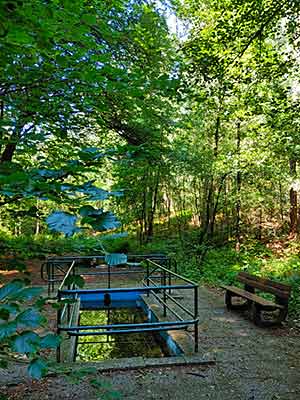
You won't believe what a wonderful feeling it is when you rub your feet dry afterwards and then take your first steps!
Don't have a water treading pool nearby? No problem, a 10-minute walk barefoot through the forest has almost the same effect!
But you have to take the time to do that and not just want to cover as much distance as possible as quickly as possible.
Connect with the nature around you, feel the ground under your feet, consciously breathe in the air and oxygen and open yourself to the sensations that arise in you.
This is a completely different form of hiking than how we normally practice it.
Forest bathing, which originated in Japan, about which you here is a separate article has perfected this form of staying in nature and offers a great opportunity to find relaxation in nature.
Close to the elements: Relax in nature by canoe and kayak
Until last year, I lived near Limburg an der Lahn. The Lahn is one of the most popular rivers when it comes to canoeing, kayaking and SUP (stand-up paddling).
And rightly so, because the water quality is usually very good, it is wonderful to swim in the Lahn and the banks are usually lush green and give the feeling of exploring the jungle.
Pure relaxation!
Fortunately, there are canoe and SUP rental stations everywhere, not only on the Lahn.
Try it out and go on a canoe trip on the nearest river together with friends or alone.
Nothing clears your head faster than gliding along on the water while the trees pass you by on the right and left of the shore.
If you want to find relaxation in nature, canoeing, kayaking & Co are definitely one of the best ways to do it!
The social component of the Friluftsliv
Especially when canoeing, another component of the Friluftsliv becomes clear: the social togetherness.
It is not for nothing that canoeing is also very popular with school classes. Canoeing is always about moving forward as a team. And overcoming challenges together welds you together - just like experiencing nature together.
But there is another component:
"Happiness is the only thing that doubles when you share it," the German-French doctor and philosopher Albert Schweitzer once aptly said.
Shared experiences not only weld us together, they make us happy. And this is even more true when these shared experiences take place in a wonderful natural environment.
No wonder the Norwegians prefer to practice their Friluftsliv together with friends or family. And this starts with the upbringing of children – a circumstance that contributes to Norway and the Scandinavian countries regularly landing in the top 10 happiest countries in the world in surveys.
Because: "Happy children grow into happy adults", as it was recently this article on Fokus online.
But social interaction and the cultivation of relationships not only make you happy, but even have a life-prolonging effect!
At least that is the result of a extensive meta-study (here is the Original text of the study in which more than 150 individual studies with more than 300,000 participants were analysed and which comes to a clear conclusion:
People who maintain intensive contact with other people have a longer life expectancy. In contrast, loneliness and the lack of social ties are about as harmful as smoking 15 cigarettes a day and even twice as harmful as obesity.
The effect of nature on health
In addition, nature itself already has a variety of positive effects on health. And that includes both the physical and mental levels of health.
Nature is good for the body
When the Japanese government banned forest bathing in the 1980s (in Japan Shinrin-yoku as a way of health prevention and recommended it to the population, the marketing measures at that time were accompanied by extensive scientific studies.
It turned out that the intensive stay in nature not only affects the Concentration of the stress hormone cortisol but even the Growth of a special subtype of white blood cell was suggested. These natural killer cells are an essential component of the immune system's defense against cancer.
In the studies, spending time in nature also lowered the heart rate and had a positive effect on the cardiovascular system and blood pressure in study participants.
This healing effect of the forest has now been scientifically proven many times.
But the forest has a positive effect not only on our physical health. Consciously immersing ourselves in the atmosphere of the forest - which is ultimately the essence of forest bathing - helps us to truly relax again overall and has equally positive effects on body and mind (more on that shortly).
Relieve stress with a walk in the woods, just let your mind wander and be very close to nature. All these are gifts that nature offers us and that you can also find in a forest near you.
By the way, you can find more about forest bathing in in this article here at Flowfeather.
However, Friluftsliv is not the same as forest bathing, although there are many parallels. Friluftsliv is also about being active in nature. Activities in nature, such as hiking, cycling or canoeing, train the cardiovascular system, boost the metabolism and thus help to reduce the risk of obesity and related diseases.
In this way, our body is trained and strengthened in a natural way. At the same time, we get fresh air, lots of oxygen and vitamin D from the sun, which also has a positive effect on our immune system.
Finding Relaxation in Nature: Effects of Nature on Mental Health
Almost more spectacular than the effects of being in nature on our physical health are the aforementioned effects of frequent and intense contact with nature on our mental health.
I can confirm this not only from my personal experience, it is also confirmed by science:
In a large-scale Study by the University of Exeter in 2013, data from 1,000 test participants who had moved within England were examined.
It turned out that those who had moved to districts with a lot of nature had, on average, better mental health than those who didn't.
The effect lasted for several years and impressively shows the positive effects of nature on the psyche and mental health.
Even more relaxing on the human psyche than green nature, however, seems to be an environment in which water is an important element.
This is the result of a study jointly conducted by the London School of Economics and the University of Sussex study carried out, in which around 20,000 people documented their current happiness at regular intervals via mobile phone app.
The data was then compared with the respective location at the time of entry.
The result was that people who spent time in nature were generally happier. But the happiest were the people who were by the sea and in coastal regions.
Result:
Finding relaxation in nature seems to be particularly easy when the element of water is present in some form – whether in the form of a sea and coastal landscape, as a lake or pond in a city park, or even just as a fountain.
That BlueHealth project of the University of Exeter has dedicated itself to this special meaning of water for mental health and investigates possibilities to make so-called "Blue Spaces" available to residents in urban regions.
If such "Blue Spaces" are embedded in a natural landscape with a lot of greenery (the so-called "Green Spaces"), the positive effect on the psyche and mental health is strongest.
Finding relaxation in nature: My 10 tips for your personal Friluftsliv experience
1) Plan your own personal Frilufts experiences in your calendar
When we are in the stress of everyday life, we tend to be the first to cross out and forget the things that would actually be good for us.
We then no longer take time to take care of ourselves and our needs.
A walk in the woods? No time.
Going for a walk through the city park with friends? No time.
A bike ride at the weekend? No time.
When we are under stress, the body and mind quickly switch to survival mode. And there is no room in it for the beautiful things that would do us so much good.
"The right time to relax is when you don't have time for it," says the American journalist Sydney J. Harris aptly.
Therefore:
Put your personal Friluftsliv appointments in your calendar BEFORE you get stressed. Then the chances are good that you will find relaxation in nature when you need it most.
2) Find relaxation in nature with a personal favourite place
Looking for a very special favorite place in nature can be a wonderful way to find relaxation in nature even in stressful times when we have little time.
On the one hand, staying in such a place regularly allows you to connect much more deeply with the nature around you than if you just pass by a spot once or twice and take a quick look at the nature around you.
Through the deeper connection with the nature around us, we feel the positive effects of nature on body, mind & soul faster than we normally do and the effects are also deeper.
On the other hand, such a personal favorite spot also acts as a reminder that ensures that you automatically relax when you come to your favorite place in nature.
In NLP (the neurolinguistic programming) one speaks of an "anchor": The relaxation is virtually anchored to the special favorite place, so that both are connected - very similar to a special song that one heard on vacation and that immediately transports you back into the vacation mood when you hear it.
Both – the deeper connection with nature and the anchoring with relaxation – contribute to us being able to regenerate and recover particularly well in our favorite place.
And such a favorite place doesn't necessarily have to be in spectacular nature. Your favorite place can also "just" be a bench in a nearby park. Or even your own balcony. The important thing is that you are outside and that you feel a sense of connection with nature at your favorite place.
3) Take time for silence
In nature, there are often moments of silence and peace. Most of the time, however, we don't even notice such moments because we walk past them thoughtlessly.
Try to be a little more mindful outside every now and then so as not to miss such precious moments.
Maybe you see a particularly beautiful flower by the side of the road and take the time to smell the flower. Or you can discover an imposing tree on the way and take the time to take a deep breath in and out and thank the tree in your mind for the oxygen the tree gives you.
When it's raining outside in a limited area and at the same time the sun is shining a little further away, you can often see a wonderful rainbow.
Take the time to perceive such natural phenomena consciously and with an open mind.
Mindfulness as the key
An important key to this: mindfulness.
Be mindful of yourself, other people and everything living around you. Consciously perceive the beauty and details of nature, the whisper of leaves in the wind or the blaze of colour of a flower meadow. Feel the earth under your feet, the water on your body, the wind in your hair and the sun on your skin.
This is how you deepen your connection to the nature around you and at the same time develop a feeling of inner balance - because the more we connect with nature, the closer we come to our own inner center.
Man is an "earth being"
Did you know: "Mensch" means "Human being" in English. The word "Human" (which is also contained in the word "Humanism" or the adjective "human" in German, for example) comes from the Latin "humus" for earth, soil, or ground.
A human being, therefore a "Human being", is a creature of the earth. We are literally "earth beings" and the more we become aware of these roots again, the closer we come to our true nature as human beings.
Regularly take the time to become aware of this connection to the earth again.
4) Learn as much as you can about nature
When we are friends with a person, we want to learn as much as possible about him. We want to know how his day went, what problems he is currently carrying around with him and what beautiful moments he is experiencing.
In partnerships, we know our partner inside out after some time. We know what special character traits our partner has, what habits he has, what dreams and desires occupy him and what worries him.
And the more we know about our partner, the deeper the connection to them. We know how our partner "ticks" and intuitively grasp what is going on with them.
Be friends with nature
If we want to be friends with nature, it's the same way.
The more we know about nature, the deeper the connection to it. In this way, communication with nature is becoming more and more intuitive and in this way we can gain important insights and insights not only about nature, but also about ourselves and our lives in nature.
In fact, this very subtle, intuitive communication can become a source of deep wisdom in life.
How can you deepen your knowledge of nature?
Take part in guided nature excursions. Join a guided hike, birdwatching tour, or other organized activities in nature.
Watch reports about nature on TV. Read books that deal with the connections in nature. Or listen to radio and podcast episodes that deal with biological and ecological topics.
In this way, you will gradually learn more and more about the nature around you and thus further deepen your connection to nature.
5) Try different activities that will help you find your form of relaxation in nature
Being out in nature already has a high value in itself. But Friluftsliv is also about actively doing something outdoors – whether hiking, paddling, cycling, fishing (which is very popular in Norway) or whatever.
But what suits you? What activity is fun and connects you more deeply with nature at the same time?
This is something different for everyone.
And the only thing that helps here is to try it out!
A very good friend of mine did exactly that together with his wife. They have tried all kinds of things for a few years: cycling together, motorcycling, skiing, hiking.
They have finally found something that connects them intensively with nature and is also a lot of fun for them: sailing.
Today they are enthusiastic sailors and spend every free minute on the water.
And they have found their very own version of the Friluftsliv.
Do it the same way and try different things. So you will also find your own personal Friluftsliv activity, with which you can find relaxation in nature and recharge your batteries in between.
6) Don't wait for the big adventure when you can have the small one
Often we live in our dreams and imagine in our minds everything we would do if we had the opportunity.
For me, it's the motorhome with which I drive through Scandinavia, discover lonely areas and great Landscape photos Make.
As important as it is to have such dreams in order to maybe make them happen at some point, if these dreams keep us from doing what is possible today, then we should put our dreams aside for a moment and return to the here and now.
Because we can only do and do in the now.
"Life is always now and never not now!", says spiritual teacher Eckart Tolle.
For me, for example, this means that I regularly go out with my camera and photograph the forest on my doorstep.
That's still better than sitting at home, dreaming of my campervan in Scandinavia, but not setting foot outside the door.
From "Kanu-Kassel", a canoeing veteran from Freigericht in Hesse, comes the quote "Better the small adventure on your doorstep that you undertake than the big one you only dream of".
He is right, even if the best thing would of course be to undertake both the small and the big adventure.
But: One is greater than zero and therefore you should think about what you can do today to bring more nature into your life, to find your own personal way of Friluftsliv.
7) Sleep in the open air
At the beginning of this post, I mentioned the group of pensioners from Norway who had decided to spend a night in a tent by a wonderful lake.
Such an overnight stay outdoors is like a little adventure in itself and can be an experience that you will remember for many years to come.
Pure Friluftsliv!
And the experience becomes even more intense if you sleep not only in a tent like us and the group of pensioners back then, but completely outdoors under the starry sky (in Norway, however, a mosquito net 😉 is definitely recommended for this).
If that seems too dangerous for you, you can also experience such a night under the stars in your own garden or balcony.
No matter what form it takes, such a night outside in the great outdoors reconnects you with nature in a very special way.
8) Find relaxation in nature through "Digital Detox"
We are used to being permanently available and having our mobile phone with us as a constant companion at all times.
On average, people in Germany look at their phones 30 times a day - young people even almost twice as often. This is the result of a Study by the business consultancy Deloitte, in which 2,000 mobile phone users were asked about the frequency of their smartphone use, among other things.
Volatile:
One Study by the University of Gävle in Sweden was able to show that the frequent use of the mobile phone increases the risk of mental illnesses, such as depression.
So switching off your mobile phone once or maybe even leaving it at home altogether is certainly a good idea.
And where better to do that than in nature?
So the next time you're out and about in the countryside, turn off your phone or consciously leave it at home and use the time out in nature to be completely in the here and now and concentrate on your senses and the surroundings.
This way you can find relaxation in nature much faster and more effectively than if you are available around the clock and permanently distracted by WhatsApp & Co.
9) Discover new places
Many, many years ago (decades is probably better 😉) I had a roommate in my shared flat during my biology studies who did something very interesting at regular intervals.
He packed up a few things, took a compass and set off: always in a straight line, no matter where the path took him.
The only exception: if he encountered private property or really insurmountable obstacles.
Apart from that, his path always led him straight ahead.
In this way, he wanted to get a new perspective on his familiar surroundings and get to know new places.
Both worked very well.
But you don't have to be so adventurous to discover new things.
Just take a new path every now and then or go to a place you've never been before.
For example, I spend a lot of time outdoors with my dog Jacky. And normally as a dog owner you have your own fixed paths, which you take again and again.
From time to time, however, Jacky makes it clear at the crossroads that he would rather take a different junction or path than we usually do.
I have discovered some of the most beautiful paths and places when I have given in to it and walked such new paths with Jacky.
So: occasionally leave your familiar paths and explore new areas. There are so many beautiful places to discover in nature.
Open yourself up to the new experiences and let yourself be surprised.
So you can discover one or the other gem even in a seemingly familiar and boring area and find relaxation in nature in places you would never have discovered otherwise.
10) Document your memories
A great way to intensify your Friluftsliv experience is to capture your experiences outside in nature in some form.
By documenting such experiences, you automatically deal much more intensively with the environment and are also automatically much more in the here and now.
And you know: The now is the only moment that really counts. Everything else is memories of the past or plans and dreams about the future.
Another advantage of such documentation:
By capturing these memories, you can keep them coming alive and enjoying them, even when you can't be outside.
How you capture your memories doesn't matter.
For me, this means above all to photograph. When I'm out and about in the forest or somewhere else in nature with my camera, I automatically come back to myself, become calm internally again, and return from such a "photo session" back to everyday life relaxed and at ease.
But you can also keep a diary about your experiences with nature, for example. In such a diary or Wilderness Journal can you insert drawings, jot down your thoughts, or even small poems - so-called. Haikus - write.
Or you can do something completely different to capture your experiences.
Just try out which form of documenting your experiences appeals to you most and whether capturing your Friluftsliv experiences helps you to become more relaxed and serene.
Most people will find that such a documentary is a good way to find relaxation in nature and get back into your center.
Result
The concept of Friluftsliv from Norway aims to find relaxation and regeneration through conscious stay in nature. It includes physical activities such as hiking, climbing or paddling as well as the conscious perception of nature and mindfulness.
Norwegian Friluftsliv is a philosophy of life that is firmly anchored in Norwegian culture and emphasizes man's connection with nature. It promotes the fulfilment of basic human needs and strengthens social bonds among each other.
How deeply "Friluftsliv" is anchored in Norwegian culture is beautifully shown in in this article by Visit Norway.
And: Friluftsliv is increasingly seen as an effective remedy for stress, because with the concept of Friluftsliv you can find wonderful relaxation in nature.
Spending time in nature has a variety of positive effects on physical and mental health, including lowering the concentration of the stress hormone cortisol, strengthening the immune system and improving mental health.
Activities such as hiking, cycling, canoeing or just being in nature are good ways to leave the stress of everyday life behind and return to everyday life in a more relaxed and serene way.
Taking enough time for silence, switching off your mobile phone more often (digital detox), discovering new places and recording your experiences and memories are other ways to make the Friluftsliv experience more intense.
Overall, Friluftsliv offers a wonderful way to relax and regain balance in nature.