

Anyone who writes about topics such as stress, resilience, inner peace and balance cannot avoid the topic of mindfulness.
In the meantime, the term is used almost inflationarily – very similar to what happened to sustainability a few years ago.
There, too, everything was suddenly sustainable, even if it didn't really have much in common with the original meaning of the term – and still has, because even today somehow everything you want to place in advertising is sustainable.
However, such an inflationary use of words does not diminish the importance of a sustainable lifestyle, nor does it make mindfulness a less valuable ingredient for a relaxed and serene life.
And especially when it comes to connecting more with nature in order to find your balance again – and that's the main topic here at Flowfeather – mindfulness is actually quite essential.
It is not for nothing that many exercises from forest bathing are closely related to mindfulness.
On the other hand, despite a lot of scientific evidence for the positive effects of mindfulness practice, I myself have my problems with regularly practicing mindfulness and integrating it into my everyday life.
That's why I would like to deal with the topic of mindfulness and especially with nature and mindfulness in a little more detail in this blog article.
And I want to look for ways for you (and I) to get through everyday life more mindfully and thus take advantage of the benefits of mindfulness – and there are a lot of them.
What is mindfulness anyway?
Mindfulness refers to the ability to consciously experience the present moment and to perceive it without judgment – i.e. not to judge it. It's about observing thoughts, feelings, and sensations without getting carried away by them.
The basic functioning of mindfulness is therefore based on the practice of attention and acceptance.
Mindfulness does not necessarily have anything to do with nature and perception of nature, because you can be mindful anytime and anywhere.
But nature offers a variety of opportunities to practice mindfulness – and it also makes it relatively easy for us to become mindful.
More on that later.
What can mindfulness look like in everyday life?
You are mindful in your everyday life, for example, if you consciously enjoy your food at lunch in the canteen by concentrating on the smell of the food for a moment or consciously paying attention to the taste of the food when chewing.
Even if you drink a sip of coffee and consciously perceive the taste on your tongue, you are mindful.

The same applies if you rinse your cup afterwards and your thoughts are not on the next meeting, but focus your attention entirely on rinsing the cup.
But also when you look out the window and feel the warmth of the sun's rays falling through the window.
There are countless ways to practice mindfulness in everyday life and thus get into a state of presence.
And presence is important.
Because those who dwell mindfully in the present moment – i.e. are present in the here and now – are no longer trapped in the problems of the past or worries about the future.
But mindfulness also encourages us to appreciate the little things in life and recognize the beauty in the everyday moments that are often overlooked.
This applies to our normal everyday life, but of course also to our encounter with nature.
Because we can also practice mindfulness there - and even particularly well, because nature appeals to all our senses and makes it easy for us to experience the present moment intensively.
And:
If you walk mindfully through nature, you can be amazed at nature even if you are not standing on a mountain peak admiring the sunset, but "only" observing a beetle by the wayside.
By the way:
The feeling of amazement, the awe, is one of the 5 super resources from emTrace® coaching.
Such superresources are superordinate emotional states that bring us back to our inner center particularly quickly and effectively (there is also a suitable micro exercise in the Daily Flow exercises).
Keeping your amazement – also and especially about the little things in life – is therefore a good way to achieve more balance and inner peace.
And mindfulness ensures that we experience the feeling of wonder more often.
What mindfulness does
I had just mentioned an important aspect of the importance of a mindful lifestyle. By "paying attention" to the little things in life, we often experience the feeling of amazement and awe, which regularly brings us back to our inner center.
But mindfulness can have many other positive effects on the body, mind and soul that go far beyond what you would suspect at first glance.
And small "mindfulness breaks" that are taken throughout the day are often enough.
If you consciously take time to linger in the present from time to time and observe your thoughts and feelings, you can benefit from the advantages of more mindfulness in life with relatively little effort:
- Stress management: Mindfulness can help clear the mind and relieve tension. Those who go through life mindfully are more likely to free themselves from stressful thoughts and achieve a state of relaxation, which can lead to a noticeable reduction in stress symptoms.
- Improved concentration: By focusing on details, we sharpen our perception and increase our ability to concentrate. This increased mindfulness can be beneficial not only in our professional lives, but also in everyday life, helping to complete tasks more efficiently and with greater care.
- Emotional balance: Mindfulness promotes a sense of inner peace and serenity. It allows us to better regulate our emotions, relax and deal with challenges more peacefully, which can lead to a more harmonious and fulfilling life.
In fact, numerous scientific studies have shown that regular mindfulness practice not only improves mental health, but can even bring physical benefits, such as lowering blood pressure and boosting the immune system. here I once linked you to an article (pdf) by Dr. Karlheinz Valt from the University of Vienna, which deals with the effects of mindfulness on the immune system).
In addition, mindfulness can even help relieve chronic pain, thus increasing the overall quality of life by teaching us to live in the moment and reduce negative thought patterns.
In our current world, which is often characterized by hectic and distractions, cultivating mindfulness can therefore be a valuable key to greater well-being and towards a healthier and happier life.
Insertion: Stress and the present
What is stress actually and why is the here and now so important when it comes to topics such as stress and hectic?
To do this, you need to know that the stress we experience is actually an evolutionary survival program of ours. It stems from the body's response to threats — the so-called fight-or-flight mechanism (actually the fight-flight-or-freeze mechanism).
As a Stone Age man, it was essential for survival to activate body and mind in the event of danger and to prepare for the situation in order to be able to react quickly and effectively (the famous saber-toothed tiger).
Once the tiger had disappeared, the system could shut down again and the Stone Age man could go back to his usual life.
Today, however, this reaction is constantly triggered by everyday stressors that we unconsciously perceive as danger – loud noises, flashing neon signs, fast cars rushing past us, and much more.
As a result, we are permanently in stress mode. And that can have many negative consequences for health.
Mindfulness can help to take the stress potential out of such situations by helping to become aware of the often unconscious reactions to everyday stress triggers.
At the same time, a regular mindfulness practice trains the ability to remain inwardly neutral, because not judging is an essential part of mindfulness.
Many interpersonal situations also have a high potential for stress, such as a difficult boss at work or problems in the relationship.
It is precisely such situations that often continue to work in our heads – we imagine our career going down the drain or constantly think about the argument from two days ago.
And that also creates stress. Because our subconscious does not distinguish between reality and imagination.
Mindfulness can also help here, because when we are fully in the here and now, the worried thoughts about the past and future also fall silent.
The practice of mindfulness
Of course, the question arises, how exactly do you practice mindfulness? What exactly do I have to do if I want to live (more) mindfully?
And as mentioned at the beginning, I have my own problems there. Because somehow it is exhausting to constantly pay attention to what your own thoughts are doing and where you are with your attention.
So first of all, it's not so easy to bring more mindfulness into life.
Fortunately, there are countless methods, directions and schools, all of which have their own paths to a more mindful life and which enable everyone to find the path to more mindfulness that is suitable for them.
One of the most well-known methods is that of Jon Kabat Zin MBSR method (Mindfulness Based Stress Reduction), which offers a myriad of practical exercises for more mindfulness in everyday life.
Instead of giving you a lot of practical exercises, however, I would like to explain a few basic principles for more mindfulness in everyday life, with which you can create your own exercises to bring more mindfulness into your life and everyday life.
And of course, I would also like to give you a few ideas on how you can practice mindfulness in nature – because there it is particularly easy for us to be in the here and now.
That's exactly why nature has become the way to more mindfulness in life for me. It is much easier for me to be mindful and practice mindfulness there.
But more on that in a moment.
And if you do feel like doing concrete mindfulness exercises in nature and at home: In my already mentioned Daily Flow – Exercises you will find many ideas and suggestions.
The art of close observation
An important ingredient for more mindfulness is close observation – a skill we often neglect. But if we take the time to really look, we discover subtleties that we would otherwise miss.
Mindfulness in this sense means looking at the world with new eyes.
In Forest bathing there is a nice exercise for this, the "extraterrestrial exercise". You imagine that you are an alien who is just loaded with his spaceship in a clearing in the forest.

The task: to find out as much as possible about the newly discovered planet.
So the alien walks through the forest and takes a close look at everything. Everything is new to him and he tries to discover as much as possible and learn about the new world so that he can tell his amazed listeners about it on his home planet.
If you walk through the forest like such an alien, you are automatically more mindful and pay attention to the little things! And of course, this is not only possible in the forest, but also in the city.
If you're not an alien on a discovery mission, here are some tips to sharpen your observation skills even without a spaceship:
- Slowness: Take your time. Enjoy the moment instead of rushing through the forest (or the city). In forest bathing, the most important exercise is actually simply walking slowly. Why not just do it in the city?
- Ask questions: Ask yourself questions about what you see. Why does it look like this? What could his story be? If what you see could speak, what would it tell you?
- Use all your senses: Use not only your sight, but also your hearing, touch and smell to get a more complete picture.
Change of perspective against autopilot
A change of perspective can work wonders. Often we are so caught up in our "automatic programs" that we don't even notice what we are doing.
We then quickly overlook the small miracles around us.
But if we change our perspective a little, we suddenly discover things that we had missed before and can recognize new meanings and connections.
A simple exercise: Sit down.
On your next walk, just take a small seat cushion with you and sit on the floor in a nice spot. Or you can sit on a wall or by a fountain.
The only important thing is that it is a place where you usually just walk past.
Then you take on a new perspective by sitting down - and that can completely change your perception.
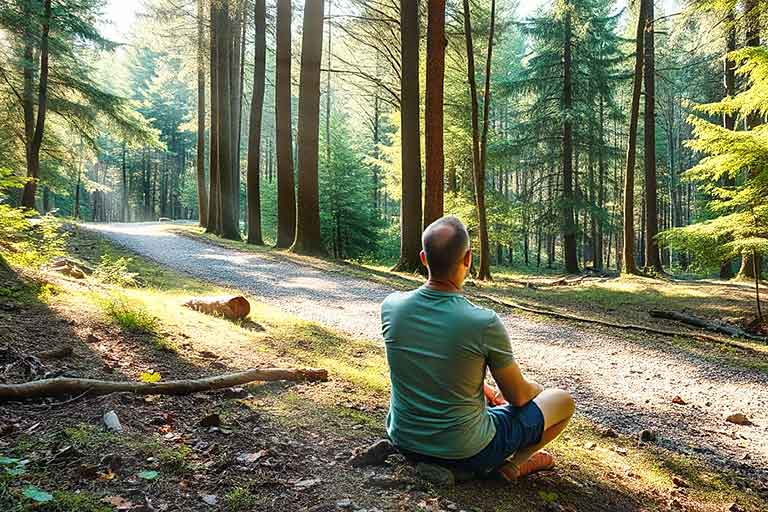
I did this exercise once in my favorite forest and sat down just one meter next to my normal path. This small change in my usual perspective alone gave me the feeling of rediscovering "my" forest in a completely new way!
However, a change of perspective in the city can also be, for example, taking a different route home than the one you are used to. Or to try a new restaurant. Or even doing something you don't normally do, such as putting your feet in the water at a fountain in the summer.
Let go of such things and experience the moment anew and perceive the present more mindfully.
Mindfulness in nature
Practicing mindfulness in nature is, in my eyes, one of the easiest ways to become more mindful.
And being mindful is particularly easy for us in nature. Because in nature we are automatically more in the here and now.
Many people therefore take a walk in the countryside to "clear their heads".
And famous personalities such as Ludwig van Beethoven or Charles Darwin were also known for using nature walks to organize their own thoughts or to stimulate creativity,
Mindfulness in nature happens almost automatically. In fact, nature is even a true "mindfulness booster"!
And there are a number of reasons for this:
- Peace and quiet: In nature, there are no (or at least fewer) civilization sounds. Anyone who enters a forest is enveloped by an atmosphere of silence in which the natural sounds blend harmoniously. This makes it easier to focus on the present moment.
- Sensory Experiences : Nature appeals to all the senses in us. For example, we hear the rustling of leaves or the singing of birds in a forest. We smell the scent of flowers or the air after a rain shower in the park around the corner. Or we can taste the salty taste of the sea on the coast. All of this can help to focus the mind and stay in the here and now.
- Visual Harmony : The natural patterns and colours of nature have a harmonious and calming effect on our psyche. For example, I find the constantly changing play of sunlight in the forest particularly impressive and calming.
- Biophilie-Hypothese : This hypothesis states that humans have an evolutionary affinity for nature that is deeply rooted in us (it's not for nothing that everyone likes to go "out into the countryside" on weekends). Therefore, we usually automatically feel very comfortable in nature, which makes it easier for us to linger in the moment and experience a feeling of mindfulness.
I had just told you about my experience sitting down in my favorite forest and how it gave me a whole new view of the forest.
The beauty of nature, however, is that even without such exercises in nature, we are automatically more mindful and more in the here and now.
But of course, you can also practice mindfulness exercises wonderfully in nature and thus strengthen the positive effect of nature on body, mind and soul.
This is exactly the approach of the Forest bathing , where there are many – often mindfulness-based – exercises that deepen and intensify the many already existing positive effects of the forest on health.
Instructions for a simple meditation
One of the easiest ways to practice mindfulness in nature is by observing a small object, plant, or animal.
Take a few minutes to do this exercise and find something that catches your eye – it could be a leaf, a stone, a flower, or even a small beetle or ant.
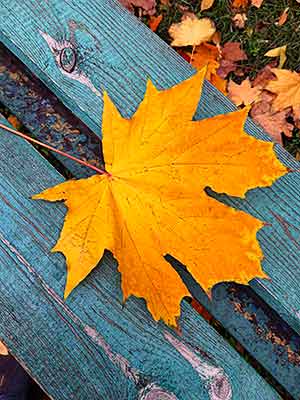
The good thing about this exercise is that it works wonderfully even in the city when you (seemingly!) have no nature around you.
Now sit quietly and look closely at "your" mindfulness object. Focus your attention on the colors, shapes, and textures of your mindfulness object.
Pay attention to all the little things. In the case of the beetle or ant, also: How does the animal move?
And further: What do you feel when you look at it? What thoughts come to mind?
Simply perceive neutrally and without judgment what you see, possibly hear, smell or taste and what feelings and thoughts arise in you.
Notice these feelings and thoughts and then let them move on. Just as if you were sitting on a riverbank and watching a few leaves float by on the river. You don't jump into the river every time to fish out the leaves.
In the picture, the leaves stand for the feelings and thoughts that arise in you and that you should mindfully perceive and then simply let move on to stay in the present moment.
This kind of "unintentional observation" can help you leave everyday life behind and be in the here and now.
You can find many more ideas and inspirations for more mindfulness in nature in my already mentioned Daily Flow – Exercises .
Mindfulness everywhere: Even in the city
Mindfulness in nature does not necessarily need a backdrop in the form of idyllic landscapes or quiet forests. Also in the city there are numerous opportunities to perceive the small wonders of nature around us.
Often it is the inconspicuous details that bring us closer to the beauty of nature.
Imagine you're on your way home from work and notice a small flower on the side of the road breaking through the asphalt.
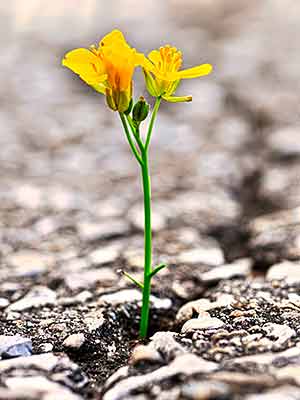
Normally, we would walk past the flower carelessly. But maybe this time you will take some time and take a closer look at the flower.
The small flower is not only a sign of the will to live, but it is also an invitation to pause for a moment and look at the world with different eyes.
With eyes that also see beauty in everyday life and that also and especially appreciate the little things in life and treat them with respect.
Thus, a small flower can create a moment of mindfulness in the midst of the urban hustle and bustle.
The symbolism of nature
But the little flower can teach us much more. It can show us that life can flourish (literally) and thrive even in difficult conditions.
The flower symbolises the resilience of nature, which we also carry within us – because also we are nature . In this way, the flower can remind us of our ability to overcome challenges and thus increase our resilience in dealing with stressful situations.
Anyone who practices mindfulness in nature and in everyday life in this way will discover many such symbols that can provide inspiration and motivation for daily life.
In nature, we also reconnect with our resources and our own strengths.
The Importance of the Everyday
When I think of mindfulness, I quickly have an image of a Zen monk in my head. I then see a monastery in the mountains and a temple bell that calls the monks to morning meditation at five in the morning.
No wonder that I sometimes find mindfulness exhausting.
It's not about becoming a "mindfulness guru" who stands on the top of a mountain in the morning and welcomes the sun.
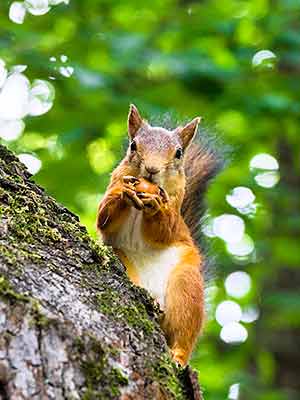
It's just about integrating small moments of mindfulness into everyday life and perhaps discovering nature in the small encounters of everyday life that even exist in the city – the squirrel that you watch on a walk and that climbs through the trees in search of food, the aforementioned flower by the wayside or the sunbeam, that falls through the open window.
To create small "Zen pockets", as I once heard in a podcast.
If we pause every now and then and observe everyday things attentively, we can discover the hidden beauty in the simplest things.
A few more examples:
- A leaf in the wind: Pay attention to how it moves, what colors it has, and how it sparkles in the light.
- The structure of a tree trunk: Feel the bark and look at the patterns that nature has left behind. This can also be done with a tree on a busy road.
- The sound of rain: Listen carefully and let yourself be enchanted by the sound of the drops. There are even said to be people who listen to the sound of rain Youtube or listen to 😉 Spotify.
A few more tips:
- Be curious: Ask questions about your surroundings. Why is this little plant growing here? What kind of animals live in this park?
- Regular practice: Take time to get outside every day, even if it's just for a few minutes.
- Keep a mindfulness journal: Maybe you even feel like keeping a mindfulness diary. "Nature journaling" is becoming increasingly popular, so why not do the same in the city and write down your own observations and impressions of nature in the city?
In this way, you can also experience nature in the city and practice mindfulness in nature in the middle of the city.
Result
Mindfulness is a wonderful way to counteract the stress and hustle and bustle of our modern world and increase our resilience.
And nature is particularly suited to practicing an attitude of mindfulness. Because in nature it is easier for us to be mindful and immerse ourselves completely in the here and now.
Mindfulness in nature invites us to look at life from a different perspective, to shift down a gear and to discover the beauty even and especially in the little things.
And this is even possible in the city.
There, too, we can practice "mindfulness in nature" by consciously perceiving the small wonders of nature, which also exist in the city, instead of carelessly walking past them.
So even the small moments and encounters in our everyday life can give us a lot of inspiration and joy.