
NATO's tuot gut!
Enrich life on all levels with the "good vibes" of natureNATO's tuot gut!
With my dog Jacky, I have been out and about thousands of kilometers in nature in recent years.
From the mountains of the Alps, to the fields and forests on your doorstep, to the great lakes in Sweden and the fells of Norway.

Again and again I have felt how much strength and energy nature can give us – if we are open to what nature has to give us.
From my point of view, contact with nature and spending time in nature are therefore among the best and most effective ways to achieve more Quality of life, health, resilience, inner peace, balance and simple more flow in life .
The Scandinavians have recognized this and celebrate with the " Friluftsliv " and the " Allemansrätt " a way of dealing with nature, which every year puts the Scandinavian countries in the top positions in the rankings for personal happiness and life satisfaction.
And science has also recognized how important nature is for humans.
Nature is good for you – from a scientific point of view
Medical research on the effects of nature on our health and well-being has increased sharply since the early 2000s. There are now a large number of studies dedicated to the question of how exactly nature affects us and our health.
All studies have one thing in common: they confirm what we have all known intuitively and from our own experience for a long time: nature is good for you!
So that you can get an idea of the scientific research on the effects of nature on our health, I have compiled a few of these studies for you here.
- In a 2010 study, a research team from the Center for Environment, Health and Field Sciences at Chiba University in Japan found that spending time in the forest lowered blood pressure in the subjects (Park, J.B. et al. (2010): The physiological effects of Shinrin-yoku (taking in the forest atmosphere or forest bathing): evidence from field experiments in 24 forests across Japan) ( Link to the study ).
- A team of researchers led by Hiroku Ochia comes to the same conclusion. In the study, both blood pressure and stress levels decreased in the test participants (Ochia, H. et al. (2015): Physiological and Psychological Effects of Forest Therapy on Middle-Aged Males with High Blood Pressure) ( Link to the study ).
- Prof. Qing Li from the Nippon Medical School in Tokyo, Japan – a pioneer in research into the health effects of the forest on humans – and his team have been able to show in various studies that spending time in the forest strengthens the immune system and even increases the number of natural NK cells, which are also relevant in the body's own cancer defense, through regular visits to the forest (e.g. Li et al. (2008), Phytoncides (Wood Essential Oils) Induce Human Natural Killer Cell Activity) ( Link to the study ).
- A team led by Gregory N. Bratman from the Stanford University in the USA was able to show in a study that spending time in natural environments reduced brooding and anxiety and at the same time improved cognitive performance. (Bratman, G.N. et al. (2015): The benefits of nature experience: Improved affect and cognition) ( Link to the study )
- A team led by Diana E. Bowler from the Centre for Evidence-Based Conservation at Bangor University in the UK compared the results of a total of 25 different studies that had examined the effects of nature on humans and concluded that contact with nature can have positive effects on mental health, general well-being, physical activity and cardiovascular health (Bowler D.E. et al. (2010): A systematic review of evidence for the added benefits to health of exposure to natural environments) ( Link to the study ).
This was only a small excerpt from the research on the effects of nature on our health and well-being. In the meantime, there are countless studies, all of which confirm that nature is simply good for us ( here I have put together an overview for you).
Nature is not only good for you, nature makes you good!
Psychologists at the University of California in Berkeley had the idea not only to investigate the effects of nature on the individual, but also to look at the extent to which nature could also be good for social interaction.
In total, they led to this four different studies in which they examined the different aspects of the effects of nature on prosocial behaviour.
The result:
Nature is not only good for the individual, nature also promotes this social interaction .
In one of the studies, simply looking at pictures with beautiful nature caused the participants to behave more socially towards their fellow subjects in the subsequent tests.
In another study, test participants who sat next to beautiful houseplants behaved more socially than those who sat next to less beautiful plants.
The effects of nature on social interaction were so pronounced that the authors recommend that people in professions in which positive emotions and social interaction play an important role regularly visit beautiful natural places in order to strengthen these qualities.
As important as such studies are, the scientific view of nature and why it is good for us is of course not the only view – and in my eyes probably not the most important one.
So let's take a look at what reasons there could be for the many positive effects of nature on us and our well-being beyond the "hard" science.
We are nature
In our society, we are used to looking at our relationship with nature in such a way that we humans are on one side and nature on the other.
This way of looking at nature is actually a relic of the mechanistic worldview especially of the 17th to 19th centuries – and it has a lot of disadvantages, as it quickly leads to the view of nature as a pure resource, as a means to an end ( here I have written about this in more detail).
I can remember having a lot of trouble with this concept as a child.
It just felt kind of weird to me. Intuitively, I already knew as a child that the Man a part of nature and does not stand apart from it.
In biology, one also speaks of the Biophilie-Hypothese . This is based on the assumption that there is a (genetically designed) longing in us humans to feel connected to nature due to evolutionary biology.
Regardless of whether this longing is genetically determined or inherent in us as spiritual beings: We long for the feeling of Connection with nature .
Probably that's why the separation between man and nature felt so strange to me as a child, precisely because there is this longing for the feeling of connection with nature in us.
In our daily lives, unfortunately, there is often little room to really feel this connection or oneness with nature.
And that's exactly why we feel so good in nature. Because there we almost automatically come back into this connection and feel that we are a part of nature.
Nature and Mindfulness
Being in nature is also a wonderful way to practice mindfulness. Of course, you can do it differently everywhere, but it's especially easy for us in nature.
Because nature appeals to all our senses: we see, hear and feel the wind, the rain, the trunks of the trees. We taste the fruit and smell the scent of the flowers.
When we are out and about in nature in this way, we automatically come back into the present moment back.
And that is the only moment in which life takes place.
"Life is always now and never not now," says Eckart Tolle , one of the most famous spiritual teachers of our time.
In this way, spending time in nature reconnects us with life.
By the way, for me, photography in nature, i.e. nature and landscape photography, is one of the most wonderful ways to practice mindfulness in nature.
When I walk through the forest with my camera or hike through a landscape, I perceive nature much more intensely. Then I am fully present and in the present moment. You can find some of the photos that were taken on my website Carsten Meyer Photography .
Enjoy simplicity
I can remember well how many years ago I was asked why I liked to be out in nature with the tent so much.
My answer:
Because camping in nature is one of the easy and essential things in life Returns. Instead of looking for the remote control from the TV or worrying about the next deadline in the office, it's about food, drink, a roof over your head and a warm bed.
Things that are simply important for life.
This puts a lot of things right in your head and helps very well to shift down a gear every now and then.
In the meantime, I find it a bit more difficult to camp, instead of sitting on the ground, I prefer to sit on a chair, but one thing has remained:
I see nature as a wonderful place to clear your head and appreciate the simple things in life again.
Watch a sunrise, smell the smell of the air after a summer rain or marvel at the stars in the night sky.
Just life simple - and that is possible in nature like nowhere else.
Natural Flow
Flow is a state in which everything is "in flux". If we are in the flow , things are easy for us, we are in the right place at the right time and intuitively make the right decisions.
Everything flows naturally.
Flow with nature
And indeed, nature is a wonderful way to bring more flow into your own life.
The more we spend time in nature and the deeper our Connection to nature the easier it is for us to open up to the state of flow.
Because flow is actually always there – we just too often close ourselves off to the natural flow of life. And most of the time we don't even notice it. Because we are stuck in the daily grind, are constantly in thoughts and are actually always busy doing and doing something.
Then we are no longer in our center, are stressed and hectic and things are somehow "no longer running smoothly" – we are no longer in the flow.
All of this falls away from us almost by itself when we are in nature.
Following the flow of life
However, "natural flow" does not only mean spending a lot of time in nature – which is difficult for people in the city anyway. Luckily, there's another way to strengthen your connection to nature and bring more flow into your life.
Namely, to orient oneself in one's life to the natural principles of life.
What does that mean?
The idea behind this is that there is such a thing as a natural order or flow of life.
Nature is not a random pile of matter, but a complex and highly organized overall system that follows its own rhythm and principles.
And it is fractal organized, which means that these principles can be found on all levels of nature.
Together, this forms what could be called the "river of life," a thought that plays a central role in Taoism and many other cultures.
If we follow this flow of life with our actions and intentions, we live (more) in harmony than if we constantly (consciously and unconsciously) fight against it.
"Non-Doing" & Wu Wei
In the already mentioned Taoism, the classical Chinese philosophy about life, there is the concept of " Wu wei " (actually Wei wu wei). It is usually translated as "acting without acting". Actually, however, he rather means "effortless action".
Instead of struggling and fighting against the tide of life, the principle of Wei Wu recommends effortless action. Doing the right things at the right time, you could also say.
Or not doing something if it's not the right time to do it.
"Non-doing".
But that is something different from "doing nothing". The latter means just sitting there and letting things happen passively.
The former means something else, namely to stay mindfully and consciously in the moment, without losing oneself in blind actionism and then to do the right things at the right moment in the right place at the right time.
Hence the "effortless doing" I just talked about. The inner state that allows us to do this effortlessly is what I call flow.
If we regularly spend time in nature or align our lives more with the natural principles of life, we experience this flow state more often and thus create the conditions for "Wu Wei".
Let your mind wander
But "non-doing" also refers to something else:
We don't have to do anything for nature to unfold its positive effects on our health and well-being.
"Healing under trees happens when we do nothing," says the Japanese Society of Forest Therapy .
We also don't always have to be active and get things done. Ticking off to-do ́s, making plans for the next day, thinking about what else we could improve where and how in our lives.
I know this quite well from my own experience.
Very quickly you are caught in a vicious circle of activity, resulting restlessness and dissatisfaction, which you then want to counter with even more planning and self-optimization and in the end you realize that life just seems to be rushing past you.
It's high time to just let your mind wander again!
"Not doing", in other words.
Sit down in nature and simply enjoy the moment - let the nature around you work its magic on you. Or make yourself comfortable at home by candlelight with a nice cup of tea and just do nothing at all.
find leisure, to use a somewhat forgotten expression. And listen – to add yet another forgotten expression.
Listening to the nature around you and listening to your own inner self – your own nature.
Nature leaves us in awe
Anyone who has ever been on the road in a breathtakingly beautiful landscape knows how quickly such a landscape takes you out of the daily stress of thoughts and puts you in awe.
In emTrace® (a coaching method), the feeling of awe – along with gratitude, (authentic) pride, relaxation and the feeling of doing something good for others – becomes the so-called "Trace". Super Resources counted.
If we experience the emotional states associated with these superresources, it brings us back to our center very quickly.
And that's exactly my experience.
During my biology studies, I spent a few weeks with a friend in the national parks of the USA.
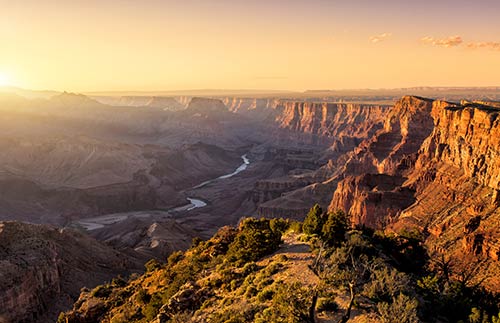
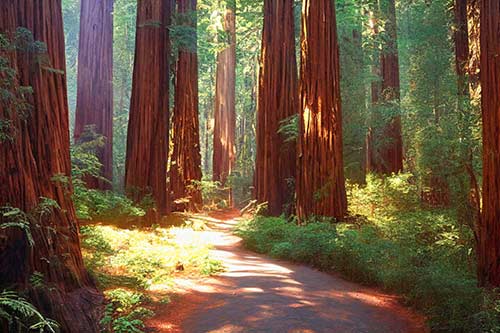
The majestic beauty of Yellowstone and Yosemite National Park, the impressive size of the redwoods in Redwood National Park or the silence of the desert landscapes in the southwest of the USA are experiences that still shape me today.
These landscapes breathe spirituality and express a sense of Sanctity of life and the earth that also has a healing influence on ourselves – in the sense of the word "holy" as "to be whole".
In our stay in nature, we become whole again and perceive ourselves as part of a larger whole.
"In the wilderness I feel the miracle of life, and behind it our scientific achievements blur into trifles," says the aviation pioneer Charles Lindbergh .
The abbess and saint Hildegard von Bingen puts it this way: "There is a power from eternity and it is green."
We can harness this power when we are out and about in nature.
And that doesn't necessarily have to be a Yellowstone National Park. The Forest on the doorstep can express the power of which Hildegard von Bingen speaks.
Because even there I can feel the energy and power of nature.

"With every step with nature, someone gets far more than they are looking for."
John Muir
Natural energy is coherent (the "good vibes")
This brings me to another point: coherence. In physics, coherence is when waves oscillate with each other in a coordinated manner. They are connected to each other as if by a kind of rhythm.
In nature, too, everything is connected to everything else on different levels and everything interacts with each other. The energy and vibrations in nature are attuned, not isolated and chaotic.
Everything in nature follows you common rhythm . In a figurative sense, we can therefore also speak of coherence in nature.
When we are in nature, this coherence also transfers to our own energy system. We then feel clearer, fresher and also more connected to the earth and the universe.
In and with nature comes our own energy back in harmony .
It is not without reason that many exercises of the Chinese movement meditation Qigong, whose goal is the harmonization of one's own life energy, have a direct connection to nature.
In our rational culture, we are unfortunately not used to looking at the world from such energetic aspects. But this deprives us of many opportunities to have wonderful experiences.
From a brilliant physicist and visionary Nikola Tesla (after whom Elon Musk named his company Tesla) comes the following quote: "If you want to know the secrets of the universe, think in terms of energy, frequency and vibration."
The retired and now deceased Stanford professor William Tiller thinks in a similar direction when he says: "The medicine of the future will be based on changes in the energy frequencies in the body."
And that's exactly what happens in nature. Our entire energy and vibrational system is positively influenced – and this is decisive for how good and healthy we feel.
It is enough for us to simply spend time in nature with an open consciousness. However, this positive effect of nature on us becomes even more intense if we connect with this coherent energy of nature in a targeted manner with suitable coaching formats.
In fact, this connection with the energy and power of nature is the central theme here at Flowfeather.
In nature, we have access to our intuition
The coherent energy of nature also influences our own energy system in another way: The more intensively we come into contact with nature, the more liberated we feel from foreign energies and disturbing influences.
We then feel more authentic and more with ourselves. And that brings us back into contact with the intuitive wisdom in ourselves.
That's why spending time in nature is a wonderful way to get impulses for your own vision of life. Hermits and monks have always used this to gain deep insights into life in nature.
The famous physicist Albert Einstein says: "Look deep into nature and then you will understand everything better."
Nature "inspired"
From the Hawaiian Huna Philosophy I have adopted an idea for myself that exists in a similar form in many indigenous cultures of this earth: Everything in the universe is Invigorating, conscious and communicative ("everything is alive, aware and responsive").
And this applies not only to animals and plants, but to everything in and outside of nature: to mountains, rocks and stones as well as to a river, a lake and even to all objects that we use in our everyday lives.
In this view, everything has its own spirit or spirit: nature "inspires".
And everything in this world has its own experience of "its" reality and is capable of interacting and communicating with its reality in some way – a view that the American philosopher, cultural ecologist and author David Abram represents.
And the German biologist and philosopher Andreas Weber also deals with the this very interesting post deals with the question of whether it is not finally time for us to "radically rethink our relationship to everything that lives".
Weber speaks of nature as a "space for the soul".
We could also say that everything in nature and in the universe is animated. Or, like the "Plant Pope" Wolf-Dieter Storl expresses it for the plants: ensouled.
This gives us the opportunity to enter into a dialogue with everything in the universe – and also with everything in nature.
Just try it out the next time you're out in the woods. Choose a tree or other plant that appeals to you. Then try to become as neutral and open as possible inside.
Formulate a question in your mind that you ask the tree or plant. And then feel inside yourself what answer arises in you.
From my point of view, in this way we actually communicate with the spirit of the tree or that of the plant.
This is also an unfamiliar thought at first, but it opens up many possibilities, new insights and ideas about life, about oneself and about the own vision of life .
Shamans and healers around the world have used this very way of communicating for thousands of years to gain a deep knowledge of nature and about nature.