
Reconnect with Nature
Connecting with nature, finding your centerIf you are wondering why and how more nature and a deeper connection with nature to help you to become calmer and more serene and better with all this stress and the demands that rain down on us every day, on this page you will find (my) answer to these questions.
You will learn, among other things,
- why I believe that nature is a very special power has in store for us, which our lives Enrich at all levels can
- which is the real reason why we permanently stressed – even when we are not actually experiencing acute stress,
- why a deeper Connection with nature can help us to improve our composure to find our Resilience and to be able to deal better with stressful situations,
- Why how more Finding relaxation in nature if we consciously experience nature and realize that we are a Part of nature are
- and what a Japanese bullet train has to do with all this.
Reconnection with nature?
In my early 20s, I once had a very impressive experience when I rode my bike home from a party in the morning.
The first rays of sunshine were shining through the trees of the forest I was riding through, when I suddenly felt a feeling of connection with the nature around me that was so intense that it almost knocked me off my bike.
Even today, over 30 years later, I can still feel the power behind this feeling inside me.
And that, although the forest I drove through back then was actually not even particularly beautiful. Just a forest like any other.
This experience showed me how much nature can become a true Source of strength in our lives if we can build a deep connection with it.
To reconnect with nature, to feel the connection with nature and life again, is therefore the Thread , which runs through everything here at Flowfeather.
Times of crisis
We live in a very turbulent time, which is characterized by new developments in all areas of society, by upheavals and uncertainties and more and more by crises and an ever-increasing number of years. increasingly aggressive social climate .
In addition, at the global level, there is climate change, deforestation of tropical forests, pollution of the world's oceans and species extinction on an unimaginable scale – to name just a few of the problems.
And things don't look any better on a personal level either.
inflation, rent explosion, a permanent Increasing work stress , worries about losing their jobs, crumbling relationships, loneliness, isolation and a seemingly increasingly uncertain future perspective.
Of course, not everything is negative and you should actually focus more on the positive things in life.
But:
The developments described are there and cannot simply be denied. And that wouldn't be good either.
It is much better to ask yourself what reasons there might be for the fact that we have all these problems today that we deal with every day – globally and each and every one of us in our everyday lives.
Because that could provide an approach to how we can better deal with these crises could.
How did we actually get to where we are today?
Of course, social developments always have many reasons that lead to some current state of affairs.
And I can't say anything about many of them, because I simply don't have the expertise to do so. I'm not a sociologist, political scientist or economist.
Nevertheless, I think I can say that a major reason for our problems today is the Overemphasis on the mind and rational thinking in our modern world.

We pride ourselves a lot on the achievements of our minds and modern science. And undeniably, science and reason have made our lives much better in many areas.
Today, technical achievements make many things easier for us that used to be tedious, time-consuming or even impossible to do.
I would even describe myself as quite tech-savvy and find the current technical developments, especially in the field of information and communication technology, really exciting.
All this has been made possible by our mind and our rational thinking. But we pay a high price for the "sole domination" of the mind.
It was precisely this problem that was addressed in 1988 by a congress in Hanover called "Spirit and Nature".
Spirit and nature
At this congress, representatives of science (physicists, chemists, physiologists, psychologists) and representatives of Christian and Far Eastern religions (Buddhism, Taoism, Shintoism) as well as philosophers met to discuss the necessities and possibilities of a holistic view of the world to discuss.
The various lectures and panel discussions held there resulted in a book edited by Hans-Peter Dürr and Walther Ch. Zimmerli, which I virtually devoured in my youth.
However, the congress has not changed much in our worldview.
More than 30 years later, we still see the mind in our Western society as the main authority and as the basis for decision-making for our lives and our actions as a society.
And of course, the mind is undeniably an important tool when it comes to solving problems. He's really good at that.
However, it becomes problematic when we begin (or continue) to regard the mind as the only instance in our lives and the silent voice of our heart – the intuitive wisdom in us – fade out more and more.
Then we get out of balance because the opposite pole to our rational thinking is simply missing.
Koyaanisqatsi – Life out of balance
One film that saw and picked up on this as early as the 1980s is the one made by American director Godfrey Reggio in collaboration with Francis Ford Coppola produced experimental film Koyaanisqatsi.
Koyaanisqatsi comes from the language of the Hopi Indians and means something like "life out of balance".
Koyaanisqatsi – Life out of balance
The film is completely devoid of audio commentary and language (with the exception of the word Koyaanisqatsi itself) and essentially consists of a sequence of scenes from our modern world, which are contrasted with scenes from nature, accompanied by dark music composed by Philipp Glass.
Very depressing (and impressive) are the hectic, alienation and destruction of a world in which man seems to have become more and more out of balance and has moved further and further away from nature.
Of course, you have to see the film against the background of the time in which it was made. And of course there is another side – not everything people do is bad and there is a lot of positive news, also when it comes to how people treat the environment.
Nevertheless:
The film shows where a purely rational and rational view of the world leads if it is not a Counterweight in the form of Intuition, introspection and wisdom of the heart – all characteristics above all (but not only) of Far Eastern wisdom teachings, which are not without reason very popular with us today.
And all things that make us more familiar with ourselves and our own nature if we would give them more space in our lives.
Find your nature
On one of the sliders on the homepage it says " Find your nature. " This slogan alludes to exactly that. Of course, it is meant to be ambiguous: On the one hand, it is about rediscovering nature, finding it and building a relationship with nature – and thus making it an important part of one's own life.
For some, that might mean being by the sea, walking along the beach and listening to the waves. For the other it may be the mountains to which he has a very special relationship, for me it is above all (but not only) the forest.
But it's also about rediscovering nature on your own doorstep – not everyone has the opportunity to spend their holidays by the sea or in the mountains.
It is therefore also a matter of recognizing the value of nature on a small scale and appreciating "normal" nature: the flowers along the way, the butterfly flying past the window or the sun's rays falling through the leaves of the trees and forming a pattern on the ground.
And also about finding (your) favourite place in nature – in other words: "Find your nature".
On the other hand, it is also about finding one's own "inner" nature in a very concrete way. “ Who am I really? " – regardless of all the thoughts, worries, all the everyday stress and the hustle and bustle around me.
We are most likely to find an answer to such questions in nature. Because that's where all the distractions fall away from us, with which we otherwise surround ourselves or by which we are surrounded.
"In the tranquility of nature you find yourself, and in your authenticity you touch the hearts of others," is a beautiful quote, the author of which is unfortunately not known.
But that's exactly what it's all about: finding yourself in nature in order to build a deep and happy relationship not only with yourself, but also with the people around you.
And by the way, we find our way to inner peace and serenity – because stress and hectic simply have no place in life if you are at peace with yourself and completely in your inner center.
Because stress and hectic are mainly caused by our thoughts and the worries we have every day about all kinds of things. If, on the other hand, we find our own nature in nature, we are completely in the now. Then we are in the flow, "it runs smoothly" and we follow the natural flow of life.
And that's what Flowfeather is all about: finding flow in life through connection with your (own) nature.
What we miss most
In order for the mind to solve problems, it divides and divides what it deals with in order to then analyze the individual parts and find a solution.
He distinguishes between himself and what he investigates and, in addition, separates what he examines further and further into its individual parts.
This also works very well, but destroys something essential, namely the feeling of connectedness.
“ […] the one who breaks something to find out what it is has left the path of wisdom ", J.R.R. Tolkien has the wizard Gandalf say in his "Lord of the Rings".
I believe that it is precisely this Feeling of connection is what we miss the most today. And I believe that alienation from nature plays a major role in this.
Because: We are not only a part of nature, we are Nature . When we move away from nature, we always distance ourselves from ourselves and our own nature.
This is how we lose the connection to ourselves, to others and to life as a whole. And that has consequences – in the form of all the problems I described above.
If I lose the connection to life, I am no longer in my center. Then I am "out of balance", as the film Koyaanisqatsi puts it.
I'm then in a permanent state of stress and radiate this to the outside world.
And if that applies to an entire society or an entire civilization, then it also has global effects – as we can see everywhere and every day.
Insertion: How the Mind Took Power
Even in early cultures, the idea of the separation of body and soul can be found. For the Greeks, it was the soul that breathed life into the body.
The French philosopher René Descartes, however, did not see the soul as a giver of life, but as the bearer of thought and the mental, i.e. the mind, whereby the mind suddenly took on a completely new position.*
And since only man is capable of higher intellectual achievements, for Descartes only man possessed a soul.
Plants and animals were "divine automatons" for him.
According to Descartes, animal cries of pain were nothing more than automated reactions to external stimuli – similar to a car horn in today's world, which sounds when you press it, but this does not mean that the car is in pain.
Descartes and his view of man and nature has deeply shaped our Western culture and continues to run through many areas of our thoughts and actions to this day.
*The philosopher Anne Sophie Meincke from the University of Vienna describes the philosophical background of our current view of nature much better and in much more detail. You can find her article on this here (the site unfortunately contains a lot of advertising banners and wants permission to send notifications, but you can deny them with one click).
Descartes' view of nature, which has shaped our Western thinking so deeply, is a major reason why we have lost more and more connection to nature.
Nature was (and is) considered a source of wisdom in many cultures and was and is deeply revered. With Descartes at the latest, nature loses this position and becomes a mere accumulation of soulless matter that can be used at will.
Our current attitude towards nature and the often missing Connection with nature are, in my view, an expression of this view developed by Descartes in the 17th century.
And the "subdue the earth" of the Christian religion has also contributed to the fact that we have lost more and more of the connection to nature.
Boniface and the Donar Oak
An expression of such a view of nature is an event that occurred in the year 723 AD:
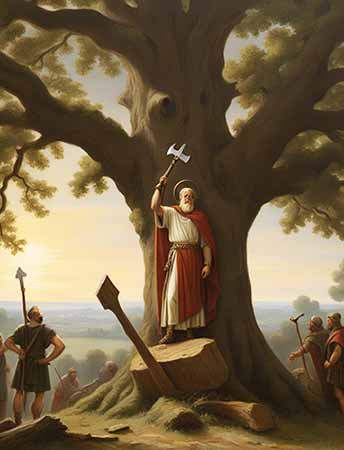
St. Boniface had the Donar Oak , a probably very old and mighty oak dedicated to the god Donar, which was one of the most important sanctuaries of the Germanic tribes – to show that the Christian god was more powerful than the Germanic god Donar.
For the Germanic tribes, trees were sacred. In their culture, it was a tree that forms the axis of the world (the World Tree Yggdrasil ).
Somehow, this story always reminds me of the attack on the home tree in the movie Avatar, one of my favorite movies.
And it shows an alienation from nature, which has been running through the thinking of the West since the early Middle Ages and which has led to us today becoming more and more aware of our own nature alienated.
After all, it is inextricably linked to the nature around us. We are not just a part of nature, we are are Nature.
And that's why I also believe that this is exactly where the Solving many of our problems today global as well as many of our individual problems.
When we reconnect with nature, we also reconnect more with our own nature and our own inner self.
In this way, we create the necessary counterbalance to the overemphasis of the mind and come back into balance (more).

"I only went out for a short walk and eventually decided to stay until sunset because I realized that going outside was actually going inside."
John Muir
In science, one also speaks of the Biophilie-Hypothese and by that we mean that we are already closely connected to nature purely from our evolution.
And that's exactly what we feel when we're in nature.
That is why we feel so good in nature and why we are automatically more with ourselves in nature and less trapped in our intellectual thinking.
And that's why reconnecting with nature is an important step – towards many profound changes that become possible when we build a deep and strong connection to nature.
"Making Friends with Nature"
All this may sound good at first. But maybe you're wondering what you get out of giving nature more space in your life and rebuilding more connection with nature?
What exactly becomes different when we see more in nature than a resource that we can use for ourselves?
Why is it worth considering the idea of making nature your friend?
"Making friends with nature", such as Serge Kahili King often formulates it.
It's worth it for many reasons. Here are a few of them:
- You can find relaxation in nature
The fact that we can find relaxation in nature sounds banal, but it is an important step towards countering the pressure of our modern (working) world. Regularly going out into nature is good for body, mind and soul and can seem like a short holiday. - You can lower your stress levels
A number of studies have shown that the concentration of stress hormones in the blood is reduced by spending time in nature. In this way, we can get out of the daily stress spiral and calm down again. - You can deal with everyday problems more calmly
In nature we can come to rest again and draw new strength, so that we can remain more relaxed in everyday life. - You can concentrate better and complete tasks in a more focused way
Various studies have shown that cognitive abilities improved in the test participants, so that they were able to solve tasks more concentrated and effectively. - Your health can improve
Many studies also confirm the positive effects of spending time in nature on our health (I have given you some studies here linked). - Your mood can improve
If you feel connected to nature, you can look forward to small everyday experiences every day. The raven you can hear calling in the trees, the sunlight shining through the leaves of a tree in the park, or a squirrel watching for a while – these things can help you develop more joie de vivre and go through the day in a good mood when you feel connected to nature. - Connecting with nature can boost your self-esteem
Those who feel connected to nature and loved by nature are not so dependent on the recognition of others. He knows that he is loved – by the trees, the mountains, the animals and all of nature. - You can reconnect with your intuition
Those who feel connected to nature can experience that they are also more deeply connected to their own nature. This gives us better access to the intuitive intelligence of our heart. - You can find a real friend in nature who can support you with many problems
I have often asked nature for advice when I have not made any progress with something. And every time I had a new idea, an inspiration or a thought after a short time that helped me move forward. This has happened to me so often now that I am convinced that it was the spirits of nature – the soulful side of nature beyond the material – that supported me. - Connecting with nature can make you hopeful
Many people who have access to nature are very concerned about nature and the earth as a whole. Recognizing that nature is animated and has its own ways and means to protect itself and react to changing conditions can provide a lot of comfort and hope.
A holistic view of the world
Especially the last points in my list above are sometimes difficult for us Westerners to understand. Other cultures often have a completely different view of the world and life.
A view from which we can learn a lot.
However, in my opinion, it also makes no sense to simply copy the views of other – mostly original – cultures and blindly adopt them (which would also be a form of cultural appropriation).
But what we urgently need in our time is a modern form of spirituality , which is inspired by these different ways of looking at the world and life, without at the same time completely ignoring our rational thinking.
A balance between head and heart, between spirit and nature, to use the title of the aforementioned congress.
Modern physics shows that this does not have to be a contradiction. It not only leaves room for a view beyond the purely material, it even emphasizes the Role of consciousness in the emergence of what we call our reality.
And thus comes very close to many traditional wisdoms of the most diverse cultures. For such a consciousness is nothing other than what might be called the spirit, spirit, or soul of something.
Shinkansen – The fastest train in the world
Japanese Shintoism, one of Japan's two main religions today, for example, looks similar to Hawaiian Shintoism Huna Philosophy everything in this world as animated—even things created by humans.
In a television report, I once saw how the two chief engineers of the famous Japanese bullet train " Bullet train " – after all, the fastest train in the world – had prayed to the spirit of the train before a test run at a small altar set up especially for this purpose in the train.
Maybe the Japanese engineers are not "from yesterday", maybe they are simply ahead of their time. Or rather: ahead of our time, because in Japan such access to technology is commonplace and normal.
Now you don't necessarily have to build an altar right away to make 😉 your TV or computer beneficial.
But:
A spiritual worldview in which not only humans, animals and plants, but all creation, including mountains, rivers, clouds and the wind, is an expression of an intelligent, communicative consciousness, would certainly contribute to the solution of many of our problems today.
And:
Such a worldview does not contradict what (modern) science has to say about the world.
Consciousness is more than a function of the brain
In our Western world, we often equate consciousness with mind or intelligence. For example, we attribute all the more consciousness to animals the higher their cognitive abilities are.
In my eyes, however, consciousness is more what you could call the creator spirit - and this is reflected in everything that has been "created".
In other words, in the whole of nature.
This insight has been an integral part of the traditional knowledge of indigenous cultures for thousands of years and which is the basis for the fact that all indigenous cultures regard the earth and the whole of creation as sacred and feel closely connected to it.
And also a finding that is increasingly moving into the focus of modern science – especially modern physics.
The physicist Federico Faggin, inventor of the touchscreen and co-inventor of the microprocessor, even decided, after a kind of awakening experience, to dedicate his entire life to researching the connection between modern physics and spirituality. Here you can find a very interesting interview with him.
In his work, he concludes that consciousness exists independently of the brain and matter. Consciousness is not a product of the brain and thought. Rather, the entire material world, including the brain, is a manifestation of consciousness.
The same conclusion is reached by the Dutch cardiologist and death researcher Pim van Lommel , who as a physician has studied the role of consciousness intensively and has conducted a number of studies with people who have had near-death experiences.
Perhaps we should finally start to rethink our one-sided material view of the world, towards a modern and holistic view that considers nature and the material world as an expression of an all-encompassing consciousness.
Developing a connection with nature, but how?
The question remains, how do I find more connection with nature and thus a holistic and at the same time modern view of the world?
I believe that there are basically two ways to rebuild more connection to nature and thus enrich one's life.
"The Great Outdoors"
The simplest: To be in a magnificent natural landscape stop.
Because then we feel the power and energy of nature very directly. And feel and automatically connected to the nature around us.
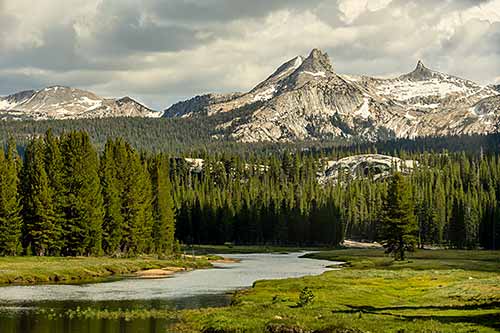
We experience a feeling of awe (Awe feeling), which studies have shown can even have a positive impact on our physical and mental health.
It's as if nature itself makes us feel connected to it.
For me, the national parks of the USA and Canada, the landscapes of Iceland and Greenland with their waterfalls and volcanic landscapes, or the fjords of Norway and New Zealand are examples of such impressive landscapes.
Some of them I was allowed to visit, others I only know from pictures.
But sometimes it's enough for me to just look at the pictures of such landscapes to feel the energy behind them.
This is also the reason why there are many such images here at Flowfeather.
Because this can also strengthen your connection with nature to a certain extent, even if this cannot be a substitute for really being in nature.
In Germany, unfortunately, we hardly have such impressive landscapes (anymore). The Eibsee, parts of the course of the Isar, Bavarian Forest, Kellerwald and Reinhardswald (still, as a wind farm is also to be built here) or some areas of the Baltic Sea coast may come closest to this.
Open to the Good Vibes
But there is a second way to build more connection with nature, which we can also use in our cultural landscape to feel connected to nature.
A possibility that comes from ourselves.
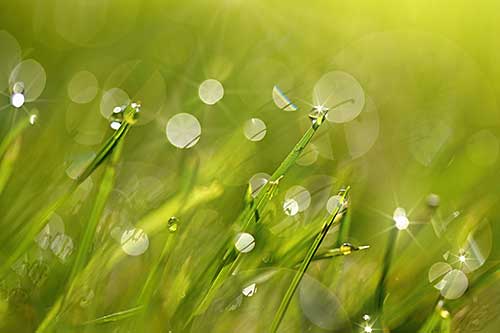
If we inwardly open for the good vibes of nature, then we can feel very connected to nature even if we "only" experience it on a small scale.
An important step in this process: Consciously experiencing and perceiving nature – an approach from the Mindfulness Teaching (engl. Mindfulness ), which enables us to encounter nature with an open mind and without judgmental thoughts.
Then the sunlight reflected in a dewdrop can release a wave of power and energy in us.
That's exactly how I felt back then during my experience with the bike.
I had already driven several kilometers when I got to this place. Constantly pedaling with the pedals can be a very meditative activity and probably contributed to me being inwardly open to the experience at the time.
But you don't necessarily have to get 😀 on your bike for that.
There are a variety of Techniques, Mindfulness Exercises and Self-coaching tools that you can use to create this inner openness.
You can find some of them in my Daily Flow Exercises – simple and short micro-exercises with which you can get out of feelings of stress and get back into the flow.
In this way you can strengthen your connection with nature, the everyday stress counter our modern times and Relaxation in nature to find.
And even if you don't have the opportunity to stand by a lonely mountain lake, but perhaps "only" have nature in the city park around the corner at your disposal.
By the way:
A wonderful opportunity to deepen your connection to nature and find relaxation in nature is offered by the Forest bathing (Shinrin-yoku), which I have already written about at one point or another.
Just give it a try!
You want to learn more about why nature is so good for us? Then move on to the page " NATO's tuot gut! “.