
In addition to inner peace, resilience is the second weapon in the fight against the daily stress and hectic pace of everyday life.
Inner peace ensures that we do not get stressed so quickly and that the hustle and bustle does not carry us away. When we rest within ourselves, we remain calm and in our inner center even when things get turbulent around us.
Resilience describes the ability to find our way back to our own inner center if we have nevertheless lost our inner balance after stressful phases.
Both together - inner peace and (holistic) resilience therefore form the basis for a relaxed and fulfilled life in flow.
In this article, I would like to take a closer look at the concept behind the term resilience. You will learn where the term comes from, what resilience means, how the term is used in psychology and what I mean by holistic resilience.
And of course, there are also practical tips and exercises with which you can strengthen your resilience and thus find your way back to inner peace more quickly.
The origin of the term resilience
The word resilience comes from the Latin word resilire , which means "bounce back" or "bounce".
Much like the term "stress", "resilience" was also originally used in engineering. So let's first look at what is meant by resilience there.
Resilience in Engineering
In technology and engineering, the term is used to describe the ability of a technical device or workpiece to continue to function under loads or adverse conditions.
Resilience engineering not only plays a role in the construction of technical equipment, but is also used in many other areas to ensure the functionality of technical systems under load – from finding more efficient methods of constructing buildings to developing better infrastructures that are less susceptible to damage in the event of natural disasters.
Resilience in ecology
The term resilience is also used in ecology, where it describes the ability of ecosystems to recover from stressful interventions or external effects and to continue to function as a system.
Especially in times of climate change, the resilience of ecosystems therefore plays an important role and is the subject of current research.
Resilience in psychology
Resilience is used in many disciplines and research fields – in addition to engineering, technology and biology, for example, also in economics, sociology and also in the energy industry.
But of course, for us here at Flowfeather, the meaning of the term resilience in psychology is particularly important. So let's take a look at what role resilience plays in psychology, what factors determine your own resilience and how you can improve your resilience.
An Early Research Study
The year 1971 is often mentioned as the "year of birth" of the term resilience in psychology. In this year, the two psychologists Emmy Werner and Ruth Smith published their so-called "Psychology of Psychology and Psychology". Kauai Study , which takes its name from the Hawaiian island of Kauai, where the study was conducted.
Although there have been scientific studies that have investigated the mental resilience of people under stress, the Kauai study is considered the most important basic study on resilience in psychology because of its complexity and scope.
In their study, Werner and Smith followed almost 700 children from the island of Kauai over a period of 40 years. About a third of the children grew up in difficult circumstances (alcohol and drug addiction of the parents, unemployment, poverty).
Most of these children fell into the same patterns as their parents in adulthood and also had problems with alcohol or drugs, were also unemployed or lived in poverty.
However, despite the difficult starting conditions, another third of these children managed to lead a happy and fulfilled life later as adults.
In their study, Werner and Smith investigated which factors were decisive for these children being successful and happy later in life despite their poor starting conditions.
In doing so, Werner and Smith laid the foundation for what is now understood as resilience in psychology.
The results of the Kauai study
The main finding that the two psychologists gained from their study was that the successful children had at least one caregiver in their childhood who made them feel valuable and who showed caring behavior towards the children.
This could be a neighbor, a teacher or even a friend of the same age.
In addition to this caregiver, there were other factors, such as the mother's school education or special characteristics that the children themselves brought with them and, together with findings from recent studies, shape the concept of resilience that is common today.
Resilience factors
Resilience is now defined in psychology as the ability to adapt and deal with stress, adversity and change.
"Bending, without breaking" is therefore a common euphemism for the term resilience: adapting (bending) to stress without breaking down. And when the stressful situation is over, you can return to your inner center all by yourself.
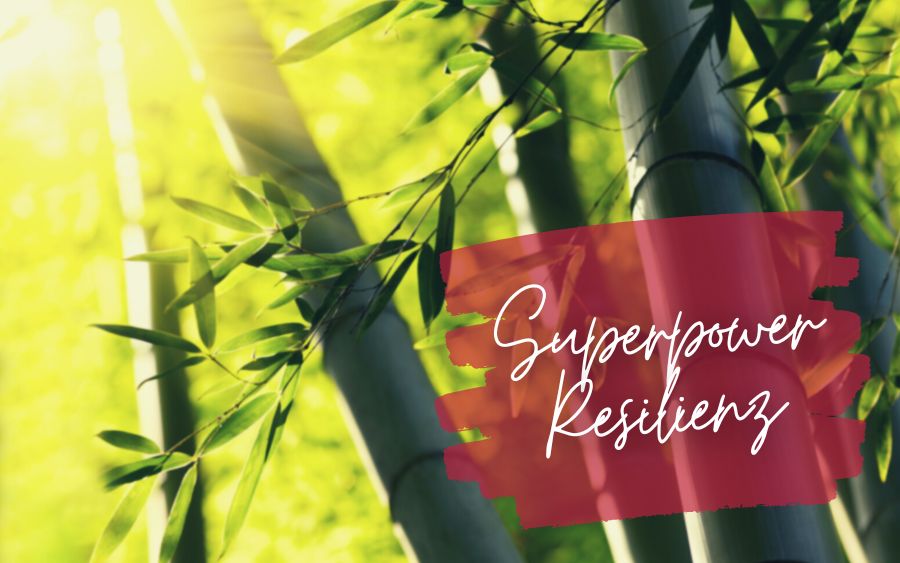
Just like the bamboo in the cover picture of this post, which yields to the wind and bends without breaking. And after the storm, it naturally returns to its original form.
Resilience is a complex, multidimensional concept that includes psychological, social and environmental factors.
Resilient people are able to recognize and manage their emotions, think clearly and flexibly, and solve problems through their own actions. They also have strong self-esteem, self-efficacy and optimism.
All these points are factors that help determine resilience and determine how well a person can deal with stress and strain.
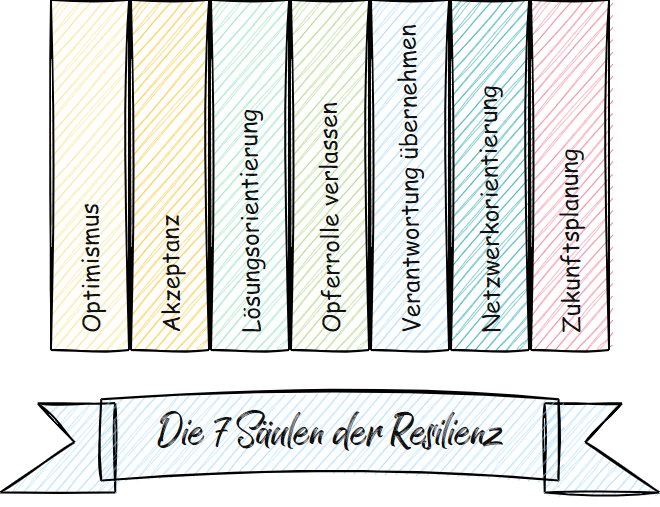
One of the most important models of the factors that influence our resilience is the seven-pillar model – the "7 pillars of resilience". The model therefore offers a good approach to improve one's own resilience.
The 7 pillars of resilience
The 7 pillars of resilience is one of many models that describe which factors determine our resilience and how we can improve our resilience.
Like all models, the seven-pillar model is a simplification. This means that there are many other factors that determine your resilience. And finally, everyone has their own preferences and their own resilience factors.
But now to the model of the 7 pillars.
The model was developed by psychologist Ursula Nuber and, as the name suggests, distinguishes 7 factors that influence our resilience.
Concrete:
- Optimism
- Acceptance
- Solution orientation
- Leaving the role of victim
- Taking personal responsibility
- Network orientation
- Planning for the future
Let's take a closer look at the individual points below.
Optimism
Optimism is one of those things. It is not for nothing that optimism as a basic attitude has fallen into disrepute in recent years – after all, optimism has far too often been understood as rose-tinted glasses syndrome.
But that is not what is meant by optimism.
Rather, it is about a kind of healthy, grounded optimism that does not deny and push away the negative sides in life, but first accepts them as a given – and then looks for ways to improve the situation.
In the article about the composure I had spoken the Yin-Yang symbol from Taoism and the philosophy behind it. In the symbol, the opposite is already inherent in each of the two basic energies.
So bad in good and good in bad, if you will.
In relation to optimus: No matter how bad a situation may look for us, somehow and somewhere something good is already laid out in this situation.
And even if it is only in the form of the possibility that the situation can improve.
"When it goes downhill, it's to get momentum," a good friend once said.
A healthy, grounded optimism focuses on the good, even if the situation is difficult at first.
Serge Kahili King, one of the main representatives of the Huna Philosophy , also once expressed it very nicely.
When asked whether he would consider the glass half full or half empty, he said: "Neither. The glass is refillable!"
That's exactly what healthy optimism is – looking for ways to refill the glass.
A little exercise on this:
The next time you're in a difficult situation that causes you stress, take a moment to reflect on yourself, accept the situation as it is, and then ask yourself:
How can I refill the glass in this situation? Even if it's just a small sip of water that goes into the glass. How can you improve the situation a little bit, even if you can't quite solve the problem?
A little tip on the side: Spending time in nature makes almost every problem a little more bearable and is therefore always a good first approach to look more optimistically into the future again!
Acceptance
In the Huna philosophy just mentioned, there is a principle that says: "Now is the moment of power" – in German "Now is the moment of power".
What is meant by this is that we can only change something if we are in the present moment. There is only the now and only when we are in the now can we change things.
And that's exactly why it's necessary to accept a difficult situation as it is. Just don't put on rose-colored glasses and pretend that everything is fluffy.
Only then can we think about how we can improve the situation.
Because: As long as we inwardly distance ourselves from the situation or problem that is currently occupying us, we are no longer in the now, but in our thoughts.
But then we can't change anything.
Acceptance does not mean accepting that a difficult situation must remain difficult. It just means accepting that she is the way she is now.
My father has a nice sentence about this that he always says when things don't go his way. He then says: "It is what it is".
This saying has become a good companion for me.
Whenever it's difficult, I say to myself "It is what it is" – and then I look for ways to improve the situation.
Solution orientation
And this brings us to the next resilience factor from the seven-pillar model, namely solution orientation.
This results almost by itself from healthy optimism and acceptance, as I have just described.
Resilient people are solution-oriented.
Instead of circling around the problem with their thoughts, they tend to circle around the solution with their thoughts.
"Do you want to be part of the problem or part of the solution?" you might ask.
And resilient people will always answer that they want to be part of the solution.
Leaving the role of victim
As long as we see ourselves as victims of the situation, we cannot change the situation. After all, it is not we who are "to blame" for the misery, but the others. The economic situation, the politics, the framework conditions.
They often make it difficult for us, but still: Even then, we can improve a difficult situation. And if only by working on dealing with the situation differently and reacting to it differently.
"It is not what we experience, but how we feel, what we experience, that determines our fate," writes the writer Marie von Ebner-Eschenbach.
Only when we get out of the victim role do we have the opportunity to influence difficult situations again. This, in turn, increases what psychology calls the expectation of self-efficacy: We again have the feeling that we can change something about the situation.
And that, in turn, puts the stress associated with a difficult situation into perspective and therefore contributes to our resilience.
Taking personal responsibility
Once we have stepped out of the victim role, the next step is to take responsibility for ourselves, our thoughts and our actions.
Responsibility is a rather misunderstood term and is often equated with: "If it goes wrong, it's your fault!"
But that is not what is meant by responsibility.
"Responsibility" means taking the right to find and provide one's own "answers" to a situation. And so taking responsibility has a lot to do with self-empowerment.
To allow oneself the power to determine one's own life again.
Of course, this increases our resilience!
Network orientation
Now we have talked a lot about what you can and should do yourself to improve your own resilience.
However, we do not live alone in this world and therefore it is important not to lose sight of the social network in your own life.
"A sorrow shared is a sorrow halved", as the saying goes, and he's right!
And this is now also confirmed by science.
In a large-scale Meta-study from 2018, the scientists even came to the conclusion that social contacts not only prolong life, but that the lack of social contacts is as harmful as smoking 15 cigarettes a day!
The study comes to a very similar conclusion Harvard Study of Adult Development , one of the longest-running studies ever.
According to this long-term study, there are two factors in particular that contribute to personal happiness – in addition to a genetic predisposition: social relationships and a relaxed life.
So it's not surprising that a good social network also increases your own resilience.
The prerequisite for this, of course, is that you talk to your friends about your problems and talk about them when you are not feeling well.
Then you can "get the frustration off your chest", gain new inspiration for dealing with a difficult situation or simply cry yourself out on one shoulder.
Planning for the future
Thus strengthened, you can then move on to the next point, which is also another resilience factor: positive planning for the future.
Resilient people don't just live for the day (although of course that can sometimes be quite relaxing). Resilient people consciously plan their future.
They have a vision of their own lives and are thinking about how they want to live in the future. They consciously choose goals that they want to achieve and think about what concrete steps they want to take to achieve these goals.
Can resilience be learned?
Basically, the answer to this question already follows from what we have discussed so far on the topic of resilience.
If I learn to better integrate the various resilience factors into my life, then of course I will also increase my resilience.
However, there is a very interesting discussion in science about the extent to which good resilience is perhaps also an innate ability that is anchored in our genes.
In fact, scientists have identified a gene that influences the strength of resilience. It is called 5-HTTLPR and occurs in a longer and a shorter variant and is involved in the control of the serotonin balance in the brain.
Serotonin is often referred to as the "happiness hormone" – accordingly, a high serotonin concentration has a mood-lifting effect, which of course makes it easier to deal with stress (resilience factor optimism!).
Specifically, the longer variant of the gene makes serotonin metabolism more effective and thus increases resilience.
But even people who have the shorter variant of the gene can "whip their serotonin balance into shape". A good way to do this is to stay in nature.
For example, a Study , which was carried out with middle-aged women, that spending time in the forest can have a positive effect on serotonin levels.
In addition to the 5-HTTLPR gene, other genes related to the expression of resilience are discussed. Among them are those that Neuroplasticity – i.e. the ability of our brain to build new neuronal connections and break down old ones – and thus contribute to better resilience.
All too complicated?
Watch this small film of the show "Planet Wissen", where everything is explained very nicely (available until 27.01.26).
So do I now have to come to terms with the fact that I may be less resilient just because I don't have the right genes?
Fortunately, no!
I had already mentioned the positive influence of the forest on the serotonin balance.
Fortunately, however, most people have the long variant of the gene responsible for an effective serotonin balance anyway, so they are "naturally" equipped with good conditions for resilience.
In addition, our genes and their effects on our lives are by no means as set in stone as was thought for many years (decades).
In recent years, the research field of the Epigenetics had experienced a boom. Epigenetics investigates the extent to which the environment influences genes – with astonishing results.
Genes can actually be switched on and off by the body, depending on the environmental conditions and the adaptation required.
Ultimately, the old insight remains valid that the genetic prerequisite, together with the environment and behavior, always determines whether and how a certain trait or trait is developed.
Conclusion: Even people with less good genetic prerequisites can significantly improve their resilience with a little practice, the right attitude and healthy behaviors and habits.
To do this, however, it is important to first become aware of your own behaviors and habits, which brings us to the next section: resilience and mindfulness.
Resilience and mindfulness
Mindfulness Mindfulness ) has become very popular in recent years. Rightly so, in my opinion, because mindfulness is – among many other advantages – also a good tool to strengthen one's own resilience.
What is mindfulness?
This question is answered relatively quickly. Mindfulness training, on the other hand, requires much more practice and endurance.
Mindfulness means consciously focusing your attention on the present moment and on what we are doing NOW – without judging what is happening right now.
But our everyday life usually looks completely different:
We are constantly evaluating what is happening. And we even evaluate what is not happening right now, when we wish for all the things we don't have at the moment ("Why can't it be Friday today?").
We also tend to do several things at the same time in everyday life – both at work and in our free time.
The phone rings in the office, but at the same time you enter a few numbers in the Excel sheet you are working on. Then the colleague from the other desk calls something over to us while we quickly finish writing the letter for a customer.
Or we check our e-mail account in between, but are actually busy planning a project.
After work, we sit in front of the TV and eat on the side, while we might even leaf through a magazine.
All situations in which we do several things at the same time.
And that causes a lot of stress for our brain. Because this is – according to the current state of science – by no means as multitasking as we sometimes assume. Among other things, this also has a Study by the Federal Office of Occupational Safety and Health loyal.
In fact, our brain is only "single-task-capable".
Mindfulness thus leads us back to what our brain is actually equipped for. Namely, to do one task at a time and to give this task all our attention.
The way to get there is through our senses.
Because: When we perceive something with our senses, we are automatically in the now, i.e. in the present moment.
This has several advantages.
The benefits of living mindfully
Mindfulness not only ends the stress associated with multitasking, but also reduces the stress in our lives in general.
Because stress arises especially when our thoughts wander and we imagine what could happen in the future. This often happens so quickly that we consciously don't even notice it, but only feel that we are tense and stressed inside.
But when my senses are completely in the present moment, my thoughts cannot wander into the future.
Mindfulness automatically calms our thoughts and thus ensures more inner peace and serenity.
You can practice mindfulness anywhere and anytime in your life. But it's especially easy when we're out and about in nature.
There we feel our "being-so" most easily, if only because nature appeals to all our senses. This is exactly the background of Japanese Shinrin-yoku or forest bathing ( here I have a separate article for you).
If you combine mindfulness exercises with spending time in nature, you turn on the "relaxation turbo", so to speak.
Another benefit of mindfulness practice:
When we are really stressed, we often don't even notice how we are actually feeling. We are then so disconnected from ourselves that we don't even notice how tense we are at the moment.
Mindfulness reconnects us with ourselves and ensures that our self-perception improves. We recognize how we are doing and perceive our own needs again.
And that's the first step to better self-care.
And one more thing:
Under stress, our body switches to fight-or-flight mode (strictly speaking, it's actually the fight-flight-or-freeze mode). Our body switches to survival mode and in this our focus is mainly on the negative. Because that's what threatens survival.
That's why in stress we lose sight of the beauty in life, which is still there.
We only see the negative and what (seemingly) threatens our security and thus get more and more into a downward spiral.
Mindfulness brings us out of this negative spiral and helps us to regain an eye for the good in our lives.
And a healthy optimism is one of the 7 pillars of resilience!
In this way, mindfulness helps us to strengthen our resilience and deal better with stress.
A little mindfulness exercise
The next time you're stressed, try the following exercise from the MBSR (Mindfulness based Stress Reduction):
Feel into the situation that is causing you the stress. Where do you perceive the stress in the body? How severe is this stress at the moment?
To do this, rank your stress perception on a scale of 1 to 10. A 1 means that you are not stressed at all, a 10 means that the stress is maximally pronounced.
What value are you standing on right now?
Now take a glass of water and drink this glass very slowly and consciously.
Be aware of every move you make. Bring the jar very slowly to your mouth. Take the first sip of water very slowly. Feel the water wet your lips, flow into your mouth, and spread there.
Feel the temperature of the water. How does it feel to have the cold or warm water in your mouth? Swallow a small sip of the water. Feel the water slowly running down the food mixer. What sounds does the water make when you drink it? What does the water taste like?
Take one sip of water at a time.
Sip by sip.
In this way, drink the glass of water consciously and with great mindfulness.
Now feel again into the situation that stressed you so much earlier. Rank the extent of the feeling of stress as on a scale of 1 to 10. A 10 means maximum stress again.
How has the value changed from before?
In addition to this little mindfulness exercise, there are of course plenty of other exercises and techniques that you can use to increase your mindfulness.
Soon there will be a separate article about it.
Holistic resilience
You now have a good overview of what resilience means, why good resilience is important for a good and fulfilled life and how you can strengthen your resilience.
For me, however, the term resilience is even broader. That's why I also talk about Flowfeather as Holistic resilience , instead of simply resilience.
But what exactly does "holistic resilience" actually mean?
Holistic – the view of the big picture
To explain what I mean by holistic resilience, I should perhaps first describe what I mean by "holistic".
In our society, we are used to approaching things very analytically and rationally. We "break down" reality into small areas and topics and then investigate these sub-areas using scientific methods.
And it usually works very well.
However, at the same time we lose sight of the whole. The world is not divided into different parts. Out in the world, everything is always a whole.
And the whole is greater than the sum of its parts!
This insight from the systems sciences means that our way of looking at the world inevitably leads to us losing important aspects in the process.
Holistic means looking at the world with a different view.
The holistic approach is about intuitive insights into the essence of the whole. It's about spirituality, synchronicities and the realization that there are "more things out there in heaven and on earth than your school wisdom dreams", to quote William Shakespeare.
Of course, this cannot be verified particularly well with scientific methods. Therefore, science tends to dismiss such holistic perspectives as "unscientific" from the outset.
But I believe that we are blocking a lot of opportunities for ourselves.
I became aware of this very impressively many years ago when I saw a report on a television report about a project of the organization "Doctors Without Borders".
Among other things, a doctor from the organization was interviewed in the report. The doctor said: "We have to get used to the idea that these alternative forms of medicine are equal, if not superior, to Western medicine."
These "alternative forms of medicine" meant not only herbal healing methods, but also spiritual healing approaches, such as those found in shamanism.
And when it comes to resilience, I don't think we should lose sight of the "big picture" either.
Holistic resilience – in concrete terms
Holistic resilience therefore goes beyond the (scientifically proven) concept of resilience.
Holistic resilience is about working with the energy behind things. It is about intuitive work with and on oneself. It's about taking a look at one's own spirituality again and finding ways to express it in one's life.
Because in my view, this also promotes one's own resilience.
Holistic resilience means living out of a sense of connectedness. With himself and with everything in this world.
And it is also about looking at how the ancient, traditional knowledge of different cultures can help us to live a happy and fulfilled life.
Whether Taoism, Huna, the mystical currents from Christianity, Ayurveda or whatever culture: What are the principles of life that are described in all these traditional cultures?
How can we use this knowledge in a modern form to bring ourselves and our lives back into balance and harmony – because in my eyes this is urgently needed.
Result
Resilience is an important building block for a happy and fulfilled life. Various resilience factors determine how well our resilience is and how we can deal with stress and strain.
We can strengthen our own resilience by strengthening the individual factors that determine our resilience.
One of several tools for this is mindfulness. With mindfulness, we increase our self-awareness, which we need to recognize where we are in the first place.
In addition to the term mindfulness, which is common in psychology, there is holistic resilience, which goes beyond the scientific concept of resilience and takes into account the traditional knowledge of different cultures.