

Our values are important guidelines that determine our actions and our goals. Behind every goal is a value that we want to fulfill by achieving the goal.
But what exactly are values?
What are values?
Values come from evaluating. We evaluate things in our lives as positive or negative. The more often we do this, the firmer the value that is formed as a result – and the more important this value becomes for us.
Such values can be, for example: freedom, security, love, courage, reliability, self-determination, loyalty, family, etc.
Our values are based on our needs. When we fulfill our values in our lives, we ensure that we meet the underlying needs.
This is also the reason why those values are often particularly important to us whose underlying needs have not been met in our lives. So where we have an experience of lack.
For someone who grew up in bondage, the value of freedom often becomes a very important value in life. For those who grew up in financially difficult circumstances, money and the security behind it become important values.
Many of our values are formed during puberty, others we adopt from important caregivers (first and foremost, of course, from our parents).
From this you can already see that there are values that we form out of our own convictions and others that we adopt, although perhaps other things are much more important to us.
We also adopt certain values from the society in which we live. Classic examples: The values of reliability and punctuality, which are still considered virtues in Germany.
Since our values determine our actions so decisively, it naturally makes sense to take a closer look at our own values.
What values do I have anyway? And: Are they my values at all or did I unconsciously adopt them at some point and now stick to them, although I actually find completely different values important?
These are questions that this article will deal with.
Why you should know your values
We have already discussed one point: You should know your values so that you can distinguish between your own values and those that you have adopted from others at some point – and which may even contradict your own values.
But there is another reason.
Earlier, I wrote that behind every goal we want to achieve, there are one or more values that we want to fulfill by achieving the goal.
Most of the time, however, we are not even aware of the values behind our goals. And that takes a lot of implementation power out of our goals.
"Know your why", they say in American.
Only when we know why we want to achieve a certain goal can we go full steam ahead to implement it.
Here is an example:
Think about a goal that you would like to achieve in your life. Maybe your goal is "I want to be a millionaire". Of course, your goal can also be completely different. Just take any goal that comes to mind and that you want to achieve for yourself.
Then ask yourself: What will be possible if I achieve this goal? In the example above: What is possible if I have a million in my account?
In our example, the answer might come to your mind that you don't have to work anymore. Question further: What will be possible if I no longer have to work?
The answer could be that you don't have to get up early every morning and drive to work, and you could spend the day with your family.
Or you just want to have more time for yourself and that's exactly what would be possible for you.
You see, now some values are already becoming visible that could stand behind your goal of becoming a millionaire: self-determination, freedom, family.
Do this "Q&A session" in the same way for the goal you have chosen for this exercise. Keep asking until you feel like you've gotten to the root. Then you know the value or values behind your goal.
With this knowledge, you can now be much more committed to implementing your goal. Or you can also consider whether there are other ways to live this value in your life.
In our example:
Maybe you won't be a millionaire, at least in the short and medium term. But you could ask your boss if you could work from home one or two days a week and thus partially fulfill the value of self-determination for you.
Or you can consider reducing your position a bit to spend more time with your family or have more time for yourself.
Or – if that doesn't work – you resolve to spend the weekends with your family as a balance or to use the weekends very consciously to do the things that are close to your heart.
These are all possibilities that you probably wouldn't have become aware of if you hadn't dealt with the values behind your goal beforehand.
Same value, different fulfillment criteria
When it comes to your own values, you should not only think about which values play a role in your life, but also when you consider these values to be fulfilled.
Is your value of freedom already fulfilled when you go hiking in the nearby forest on the weekends or only when you drive along the Pan America in a four-wheel drive motorhome?
And: While for some freedom has to do with going out, others may feel free if they have decision-making freedom and personal responsibility in their job.
We say that the fulfillment criteria of each value can be different.
Another example of this, which I got to know in my NLP training and which illustrates the role of the fulfillment criteria very nicely:
In the 1970s, both flower power supporters and their parents had the value of "good looks". But the fulfillment criteria were completely different.
While the mothers saw the chic costume as a fulfilment criterion for good looks, for the daughters floral shirts and sunglasses were the corresponding fulfilment criteria.
The same applies to fathers and their sons, where the short-cut, well-fitting hairstyle on the one hand and the long, wild mane on the other hand were the fulfilment criteria for good looks.
As you can see, it's not enough to think about your own values. It is just as important to consider when and how you consider your own values to be fulfilled.
This is the only way you can ensure that you actually live your own values. And that is one of the most important criteria for a happy and – in the truest sense of the word – fulfilled life.
The Values and Development Square (Schulz von Thun)
There are countless value models that list the different values and relate them to each other.
However, most of these models are too complex for personal use, so I won't go into detail here – with one exception.
The value and developmental square of the communication psychologist Friedemann Schulz von Thun shows very nicely the relationship of values to their so-called countervalues.
And that can actually help you if you think about your personal values.
Basic assumption of Schulz von Thun's value model:
Every value needs a positive countervalue in order to unfold its constructive power. Or the other way around: Without its positive countervalue, every value quickly becomes a rigid principle that restricts rather than enriches one's own life.
Here is another example:
Think of the value of security. First of all, that sounds like a good value. After all, going through life safely is a positive thing and the value of having security in life can't hurt.
However, if you are always concerned about your safety, you will very quickly become overcautious and anxious. Such a person is hardly willing to take a risk and restricts himself and his life further and further.
The result: You always stay in your own comfort zone - because you know it and it conveys the security you want to achieve for your life.
What is missing is the positive counterpart to security, the willingness to take risks. Only when the value of security is supplemented by the value of willingness to take risks does an area of tension arise in which both values together can actually enrich one's own life.
Here I have the diagram from the corresponding Wikipedia article for you (source: SvT Institute: Diagram of the square of values and development according to Schulz von Thun , CC BY 3.0 )
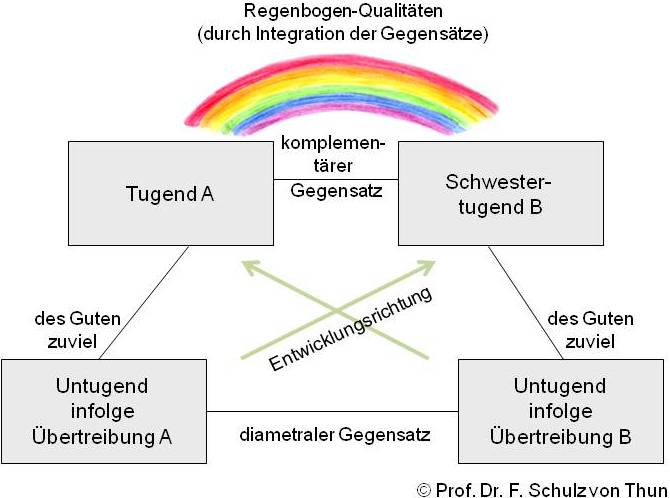
Schulz von Thun speaks of virtues, but what is meant here are the values. Too much of the value of security becomes a vice in consequence of exaggeration—the over-cautiousness of which I have spoken arises.
The equivalent of risk-taking becomes recklessness when exaggerated. This should evolve in the direction of security (the diagonal arrows "Development direction" in the diagram) so that the original security value is strengthened again.
Only the integration of both values leads to a positive influence on one's own life (the rainbow in the diagram).
Try using the value and development square for value pairs from your life. You'll be surprised how much insight you can gain from it.
Values as a source of strength
If we get into a situation in which two different values play a role, but which we cannot fulfill at the same time, we get into a conflict of values.
Imagine that you have the value of security in your life. At the same time, the value of family plays an important role for you.
You are successful in your job, but you have the feeling that a certain colleague would like your job and therefore makes a special name for himself in his work.
In order not to jeopardize your position in the company and thus be able to continue to fulfill your value of security, you are now particularly committed to your job. Maybe you take on additional projects, work overtime or take on additional functions in the operational process.
All to make it clear to your boss that you are the right employee in your current position.
The problem:
At the same time, your value family is getting more and more into the background. You feel torn between the values of family and security.
You are in a conflict of values.
Such conflicts of values cause us to feel torn inside, which means that a lot of energy is lost. In the long run, we then feel exhausted and powerless.
So the goal must be that we live in harmony with our values. Then we are in our center, because we are not torn, have access to our energy and go through the day powerfully.
However:
It's not always easy. But it will at least be easier if we are aware of such a conflict of values in the first place. As long as we only notice that we are going through life without energy, without knowing the reason for it, we cannot react to it.
If we know the underlying conflict of values, we can, for example, consider whether we might want to redefine the hierarchy of our values for ourselves.
In the example above:
In this situation, you may consider that the value of family is more important to you than the value of security and discuss the situation openly and honestly with your family.
That would at least be a good start.
Practical value work
Now that we've talked a lot about the theoretical background of values and their significance for a fulfilled life, let's take a practical approach.
Take about half an hour to an hour for this exercise and make sure that you are not distracted during this time. The best thing to do is to switch off your phone and cell phone.
If you want, you can put on a little inspirational music or you can stay in silence for this exercise. You may also want to go out into nature for this exercise, because there we have particularly good access to our intuition and our inner self.
Do this in a way that feels right for you.
Grab a piece of paper, a notebook, or jot down your thoughts in a Word document or note-taking app.
Then go inside yourself and ask yourself which values are important to you and play a role in your life.
It is best to do this exercise in several runs, each separately for your private and professional values, because our values are context-dependent: What is important to you at work does not necessarily have to be equally important in your private life.
Write down everything that shoots through your head in terms of values.
Don't evaluate anything at this point, but write down all the values you can think of below each other, so that at the end of this exercise you have a much less extensive list.
If you can't think of any values, just ask yourself
- What do you spend money on in your life?
- What do you invest time and energy in in your life?
Then ask yourself what values are behind your answers.
Own or someone else's value?
The next step is now to separate your own values from the values you have adopted. Of course, an inherited value can also become a value in its own right.
But here it is now a matter of identifying the values that do not or no longer belong to one's own life and to cross them off the list.
To do this, go through each value in your list and ask yourself the question for each value: "Own value or inherited?".
Approach this task as intuitively as possible and pay attention to the feeling that arises spontaneously in you in response to this question.
Cross the values off your list that are not your own values.
You don't have to be afraid that you accidentally delete a value that actually belongs to you. You can repeat this exercise at any time, so you won't "lose" any value.
Once you've reduced your list to your own values in this way, the next step is to sort your own values.
Sorting values
Next, you should sort your values according to their importance. After all, not every value is equally important to us.
Getting clarity about which values are particularly important to us can prevent us from getting into a conflict of values and thus contributes to feeling completely and in our center inside.
Take the first two values of your list and think about which of the two values is more important to you. This value goes to the top of the list, the other value below it.
If you have no idea which value is more important to you, you can do the following thought experiment:
Imagine a situation where one value is 100% met, while the other value is 0% met. Then imagine the situation the other way around. One value is now 0% fulfilled, the other 100%.
Which of the two situations would be more acceptable to you? That's the more important value for you.
An example.
Imagine you have the two values of honesty and kindness. Now you go out for a meal with friends in a restaurant. After the meal, the waiter asks if everything was okay.
In fact, it was, but you didn't really like it either.
Should you tell the waiter or should you ignore it – because "handcrafted" everything was fine with the food.
Now just imagine yourself exuberantly – and completely dishonestly – praising the food beyond measure (0% honesty) and being very friendly (100% friendliness). Then imagine telling the waiter exactly what you didn't like about the food (100% honesty), but being very unfriendly to the waiter (0% friendliness).
Which of the two fictional situations feels more acceptable to you? The value behind it is the more important value for you.
In this way, sort the values on your list according to their importance.
The value line
The establishment of a value line is a technique from NLP (Neurolinguistic Programming). The aim is to put the pictorial representations of the values in an imaginary order.
Sounds complicated, but it's not.
Just imagine a picture for each value on your list. Just see what inner image spontaneously arises in your head when you think of the first value on your list.
Where do you see this inner image? Rather in front, behind or to the side of you? Rather above or below your visual axis?
Make a note of the position of the image next to the value on your list.
Do this with all the values on your list. Then mentally connect all the pictures with an imaginary line. This is your line of values.
So what does this line of values do for you?
It allows you to experiment with your values. Because: Depending on the importance of the value for you, the position of the corresponding image in your value line also varies.
Our brain "codes", so to speak, the importance of value in the spatial position of the corresponding inner image.
While simply swapping the order of the values on your list is more rational and ensures that you develop an awareness of the importance of the different values, when you work with the value line, you also change the importance of the values on a deeper level.
You can use this to change the importance of your values for you so that the whole thing is more coherent for you afterwards and feels better for you.
Because we not only adopt values themselves from others, but also the importance we give to certain values in our lives. And sometimes this does not correspond to what we ourselves would give to these values in terms of importance in our lives.
Experimenting with the value line
Think about the first two values on your list. Where were the associated inner images?
Now just swap the positions of these inner images. Mentally, move the inner image of the second value to the position of the inner image of the first value and vice versa.
Also try to change the distance between the pictures.
Let the new positions and the distance sink in a bit. What does that do to you? How do the new positions feel to you?
If the new positions and the new spacing of the images feel better, leave them as they are. If not, swap the positions back and change the distance of the inner images belonging to the values back to the way it was before.
If you want to intensify the exercise, also think of a reason why the respective pictures should be in the new (or old) position.
This way, go through all (or at least the most important) values of your list.
In the end, you will receive a new value line that corresponds much better to your values and that will be available to you as an important orientation and decision-making framework in the future.
Living one's own values
Of course, the whole confrontation with one's own values is of little use if we don't live our values at all. Those who constantly violate their own values are constantly living in a conflict of conscience.
In the long run, of course, this is not good and leads to us going through life internally torn and tense.
Therefore, at the end of the exercise, you should also consider how much you actually live it in your life with your values for each value.
To do this, go through your list again and consider how much you live each value on a scale of 1 to 10. A 1 means that you are not living the value at all, a 10 means that you are fully living the value in your life.
Take the value that comes to mind spontaneously and write it next to the value on your list.
Especially with the important values, you should make sure that they also play a practical role in your life.
If you realize during this exercise that you do not live the value or only very little in your life, do not blame yourself for it. Then just take this result as an opportunity to do better in the future.
By the way, a good way to do this is to make an annual plan at the end of a year or at the beginning of a new year, in which you think about the most important goals that you want to achieve and implement in the new year.
As part of such an annual plan, you can think about how you can better integrate the values that you have not really lived yet into your life in the future.
Or you can work regularly with the Wheel of Life – another tool when it comes to working with one's own values, which focuses on the essential values in one's own life and shows very clearly where one currently stands in life.
If you want to work really intensively with your values, you can also make a list of values for each of the areas of the Wheel of Life as described above and then do the values work exercises with this list.
Result
Values are important guiding frameworks in our lives that help us to make the right decisions (for us) and to live in harmony with ourselves overall.
At the same time, values are the motivational basis behind our goals and help us not only to choose the right goals for our lives, but also to find the perseverance and commitment necessary to achieve these goals.
Dealing with one's own values is therefore an important step when it comes to consciously shaping one's own life and finding and living one's own vision of life.