
After the first part was about why more contact with nature is a good idea and the second part is about where While we can still find and deepen the contact and connection with nature in Germany, the third part is now less about the "why" and "where", but more about the "how".
How can we do more Connection to nature even if we no longer have a primordial nature around us?
What can we do in concrete terms? do to bring more nature into our lives and thus also more in contact with our own nature (see Part 1 )?
In addition to many "classic" ways to do this, I will also introduce you to some more unusual methods that you can use to make nature an important part of your life again.
Just try different suggestions and use what works best for you.
- Bring nature into your home
- Microadventures
- Outdoor Adventure Weekends & Retreats in Nature
- Consciously perceiving the natural elements again
- Observing clouds
- Starry sky
- Crawling friends
- The world of birds
- Nature and landscape photography
- Listening to your own body
- Eat consciously
- Meditation & Mindfulness
- The Energy of Nature
- Micro exercises (Daily Flow)
- Apps
- Nature & Media
- Pets
- Result
- End
Bring nature into your home
The simplest and perhaps most obvious way to get more nature in your life when you don't have one around you is probably to simply bring nature into your own four walls.
And there are a whole range of ways to do this.
Green balcony and houseplants
I've also been thinking about the possibility of turning your own balcony into an oasis for nature Part 2 of this series. Therefore, here is only a brief reference to it.
But even if you don't have a balcony, you can make your apartment a place where you can feel the power of nature and recharge your batteries every day.
How?
With houseplants!
They not only look beautiful, but also help you feel more deeply connected to nature.
In fact, just looking at houseplants has a positive effect on our mood, stress levels and mental well-being.
The journal Psychologie Heute points out in its article " Let plants be around me! " refers to a study by Spanish and Japanese scientists that investigated exactly that. The researchers found that the test participants in offices with plants felt less stress and assessed the work more easily than the participants in rooms without plants (here the Original text of the study as PDF).
Plants in the office and in the home not only reduce stress levels, they also improve cognitive abilities and make us more productive.
British researchers at Cardiff University found out that plants in the office were able to increase productivity by 15% in field trials. And Dutch scientists were able to of a study prove that plants in schools could improve children's cognitive performance.
With plants around us, we can work more effectively, which can further reduce the stress associated with work.
And these effects can be further enhanced if people actively care for and care for "their" plants – according to the result of a Taiwanese study .
But houseplants not only have a positive effect on our mental health, they also have positive effects on our physical health.
For example, a research group led by Jie Yin from Tongji University in China found a Study found that in a plant-enriched environment, not only did the participants' short-term memory improve, but blood pressure also decreased significantly compared to the control group.
Particularly interesting: These effects even occurred in a comparable way when the test participants were not actually in an office equipped with plants, but only "visited" it virtually with a VR headset (on the topic Virtual Reality see below).
Pictures of nature also have positive effects
Apparently, even looking at pictures of nature has a positive effect on our well-being and physical health.
This is also confirmed by a Study of the University of Koblenz, which investigated the recreational effect of nature images in comparison to photos of urban environments and simple drawings.
So if you don't have the opportunity to have plants in your home (because you travel a lot, for example), then just hang pictures of great natural landscapes, forests or even just individual plants in your home.
This also helps to increase well-being and build a deeper connection with nature.
In Huna by the way, it is assumed that looking at and empathizing with nature photos creates a kind of energetic connection to the landscapes, plants and animals shown on them.
The images help to maintain focus and this in turn provides the energetic connection.
In this way, we can feel the energy of these natural elements and make it tangible.
This is not a scientific point of view, but I think it is a very helpful approach to explain the importance of nature images on our well-being and to make it practically usable.
And finally, the results of the research also coincide well with the way Huna interprets the effect of images of nature.
Microadventures
A few years ago, I once watched a video of " Canoe Kassel ", an enthusiastic nature lover, canoeist and everyday adventurer, who reports on his ventures on his YouTube channel.
In it, he said something that somehow appealed to me:
"Better the little adventure on your doorstep than the big one you never do."
He is right!
Instead of always dreaming of traveling the Yukon one day, we should focus on what we can do today to satisfy our thirst for adventure.
It doesn't always have to be the big, wide world. There is also a lot to discover on your own doorstep:
- The multi-day hike in the nature park next door, where you have not planned the overnight stays in advance
- The bike ride, where you ride a route you've never ridden before
- Overnight stay with sleeping mat and sleeping bag on your own balcony
- Canoeing on the nearest small river
These are all small adventures that can enormously increase the quality of life and at the same time enable a deeper connection to nature.
In the meantime, this approach of the "small adventure" is even known under its own name in everyday life: microadventure.
There are even entire books (Advertising) , which are all about what microadventures you can do and how best to approach them.
And:
Enthusiastically starting "your" micro-adventure at the weekend does not mean that you will not go 😀 down the Yukon with a canoe at some point.
Outdoor Adventure Weekends & Retreats in Nature
Outdoor workshops and retreats in nature are further opportunities to get more in touch with nature again. And similar to microadventures, it doesn't always have to be the Amazon or the island of Bali where you take advantage of such offers.
After all, both – outdoor workshops and retreats – are more about the how than the where. And that's why you can do both wonderfully in Germany.
Admittedly, not in every city, but maybe there are interesting offers in your area.
Outdoor workshops
Outdoor workshops are now available in many parts of Germany. Especially in the wake of the Corona crisis, outdoor workshops have experienced quite a boom, after all, these workshops are also about how you can live (and survive) in nature away from your usual civilization.
And after the supply bottlenecks of the Corona crisis, this has become more of an issue for many than it was before Corona.
And indeed, such outdoor workshops are about skills such as building shelters, finding food in nature, orienting yourself or assessing the weather - all things that can bring you closer to nature again.
Unfortunately, however, many providers have the feeling that it is more about asserting oneself in the fight with nature than about living in harmony with nature.
So also pay attention to how you feel about different offers and decide on those that make you feel good.
Fortunately, there are also many offers that focus on appreciation and connection with nature in the outdoor experience.
A quick Google search should provide you with some suitable offers in your area.
If you then decide to do such a weekend, you should of course also make sure to book your experience with a certified provider.
(Natural)Retreats
In contrast to the outdoor experience offers, the focus of a retreat from the outset is on withdrawing from everyday life for a limited time and finding oneself again. Retreat means "withdrawal").
A retreat is about bringing your mental, emotional and spiritual energies back into harmony, gaining new insights for yourself and returning to everyday life with new strength and energy.
There are retreats on all kinds of topics, such as yoga, meditation, nature perception, painting and creative expression, digital detox and many more.
And many such retreats take place in places in beautiful nature. Precisely because nature supports us so much in finding our own nature.
Even on a yoga retreat or a retreat that involves painting nature, you automatically deepen your connection to nature in such a retreat.
And there are also many retreats that are specifically designed to strengthen your own connection to nature. A Google search with "retreat, nature" will give you many results.
You can also find many retreats on the website of retreaturlaub.de (but this is only as a research hint, I have no personal experience with this provider).
Consciously perceiving the natural elements again
In our modern world, we usually live quite isolated from nature and the natural elements.
A study conducted by the opinion research institute YouGov on behalf of VELUX Survey with 16,000 participants even showed that we spend an average of 90% of our time indoors – with all the consequences that this has for us:
Lack of sunlight and the resulting vitamin D deficiency, poor air quality due to higher pollution levels in the living air and also alienation from nature.
And when we do feel the elements of nature on our skin, we usually quickly run back to the next building. Just don't get wet or let the wind ruffle your hair and clothes!
Best time ever
But do you know what was one of the best experiences of my life? When I was on holiday with my parents and sister in the foothills of the Alps when I was young and we were surprised by a torrential rain.
We were all soaked to the skin, the rain was pouring down on us and we could hardly see the path we were on.
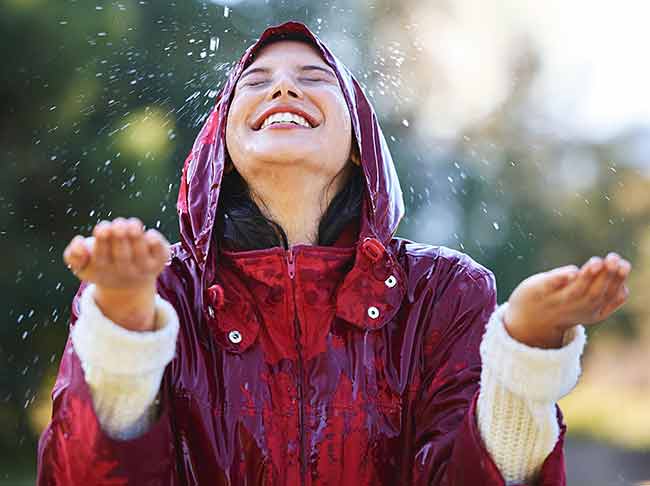
Feel the rain on your skin again!
There was no house far and wide and we still had to walk a few kilometers to the car.
But after we came to terms with the fact that we were wet to the bone, we had the fun of our lives.
I can still remember this feeling today – and the experience back then was decades ago!
So why not just walk out the next time there is a rain shower, instead of walking in?
It is clear that this should not necessarily happen during thunderstorms and storms.
But simply feeling the rain on your skin again can not only trigger a deep feeling of connection with nature, but is also a lot of fun!
Become a nature detective!
On your next walks, make it your mission to look out for opportunities where you can really get in touch with nature again:
- Feel the rain on your face? Check!
- Let the wind really tousle your hair? Check!
- Digging in the earth with your hands? Check!
- Put your feet in the water at the next opportunity? Check!
There are so many ways to feel the elements of nature up close again. From now on, take advantage of this great opportunity to reconnect with nature!
Observing clouds
Especially for people who live in the city, watching the clouds in the sky can be a good way to get back in touch with nature.
Because almost everywhere we have a clear view of the sky – even in the office there should be the opportunity to look out of the window regularly and watch the clouds pass by.

"The clouds reflect the infinity and beauty of nature."
Friedrich Hölderlin
The unintentional observation of the clouds brings us closer to nature. It relaxes the eyes, stimulates the mind and imagination and simply does you good.
As children, most of us knew this.
Maybe you can still remember how as a child you stretched your face up to the sky while lying in the grass, watching the clouds and seeing which figures and mythical creatures you could recognize?
Tom Sawyer sends his regards!
And he reminds us that even as adults, we should do what we loved doing as children from time to time.
A positive side effect: If you regularly observe the clouds in the sky, you will also get a sense of how the weather is developing - another building block for a deeper connection with nature.
Maybe you even want to combine observing the clouds and the sky with taking pictures (see below). Then you can create a whole "cloud collection" or even deal artistically and creatively with the topic of clouds and sky.
Starry sky
I can still remember how amazed I was as a child when I was allowed to stay up late and saw the stars in the night sky late at night.
And even later, when I was older and came home from a party at night, I often stood in amazement at the front door and looked at the starry sky.
The sheer vastness and the huge number of stars simply overwhelmed me.
In English, this feeling is called the "Awe feeling". And in emTrace®, a coaching method, this feeling is one of the five super resources – feelings that very quickly bring us back to our center and balance.
And by the way, looking at the night sky in amazement also strengthens our connection to nature - because the stars are also part of nature.
When we look at the starry sky, we literally feel that we are part of something bigger.
Unfortunately, the increasing Light pollution It is becoming increasingly difficult to enjoy this sight.
So if you have the opportunity and are out and about in a sparsely populated area late in the evening or at night, then take the time for a short "stargazing stop".
I am sure that this time is very well invested and will pay off twice and three times for you.
Crawling friends
From the immeasurable expanse of the starry sky to the exact opposite, the world in miniature. Because it can also relax us and deepen our connection to nature again.
On your next trip to the forest, take the time to "take a closer look" at the forest floor (preferably with a real magnifying glass!).
You will probably discover the first ants, beetles, small arachnids and other "creatures" after a short time.
The forest floor is alive!
And observing its little inhabitants can be an exciting and at the same time relaxing activity.
Even in the city – in the park or even on the balcony – you can do this type of wildlife observation and experience nature up close.
And if you don't have insects visiting on your balcony: How about an insect hotel, which you can find in every hardware store and with which you can make an important contribution to the protection of insects?
However, make sure that you have a suitable insect hotel in which living spaces for competing species are not placed next to each other and in which the right materials have also been used (see link above).
The world of birds
If you're not quite comfortable with the insects and spiders, how about bird watching?
This is also a simple and almost everywhere easily accessible way to get more in touch with nature again.
And watching our feathered friends is not only fun, it even has positive effects on our physical and mental health.
This is the conclusion reached by a Study a research group led by Nils Peterson from the University of North Carolina (click here for the Original text of the study in the Journal of Environmental Psychology).
And also one from King's College London study carried out comes to the same conclusion.
But not only bird watching makes us happier, even the pure Listening to birdsong has lowers stress and increases well-being. And that even if the singing is only played.
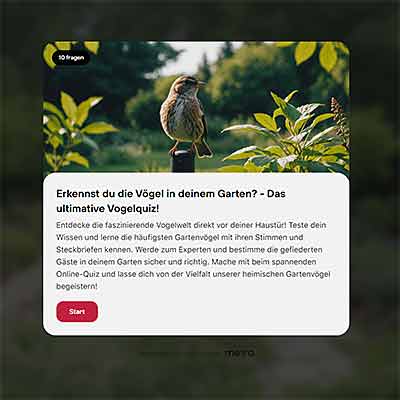
Quiz: Garden Birds
Start now!Test your knowledge of the native birdlife in your garden!
In 10 questions, you will not only test your knowledge of our garden birds, but also learn a lot of new things about the bird world. So, let's go!
If you have now acquired a taste for it, then perhaps the book " The power of birdwatching " by Angelika Nelson and Holly Merker.
With their birdwatching medicine cabinet, the authors have created a book that shows the therapeutic effect of birdsong and the healing power of nature.
Rather than just conveying facts, they invite readers to discover birds with all their senses and find inspiring commonalities between bird behavior and human life.
The heart- and soul-healing work, for which there is also an accompanying app, offers impulses for observing, listening and thinking and is therefore a real treasure for those who want to strengthen their connection to nature.
By the way: If birdwatching is something for you, then be sure to check out my app recommendation for it further down in this article.
Nature and landscape photography
My parents gave me my first SLR camera when I was still a child. I was mega proud and even then I loved to go out with my camera to photograph animals and plants.
And even today, the Photograph for me one of the best and most beautiful ways to get in touch with nature and deepen your own connection with nature.
Why?
Because I perceive the nature around me in a completely different way when I'm out and about with my camera.
Photography as a mindfulness practice
I am much more in the moment and perceive my surroundings more consciously when I am looking for beautiful motifs.
In this sense, you could say that photography is also a kind of mindfulness practice in nature for me.
I also consciously take a lot of time when taking pictures. It may well be that I spend several hours in a particularly beautiful place.
On such occasions, I have often noticed how quickly and superficially many people "rattle off" even beautiful places in nature.
On the other hand, if you consciously spend time in a place in nature, you can connect with the place and nature in that place in a completely different way.
Maybe an incentive for you to just go out with your camera and explore nature photographically?
And thanks to smartphone cameras, this is possible for almost all of us without much effort.
Forest Photography
Not everyone is lucky enough to have impressive and inspiring natural landscapes on their doorstep – unfortunately neither am I.
In such cases, the Photography in the forest can be a wonderful solution.
Because self-managed forest forests offer many wonderful motifs for photography and by the way, spending time in the forest has a lot to do Positive effects on body, mind and soul.
And if you take the forest floor in the viewfinder when taking pictures, you also benefit from the so-called "microbial fog" - because bacteria live in the forest floor that have been proven to improve mood and even have an antidepressant effect.
Admittedly, photographing in the forest is associated with special challenges, because forests are usually very "chaotic" and it is difficult to find a harmonious image composition.
But with a little practice, your pictures can become more and more an expression of the feeling that everyone has when they are out and about in the forest.
Image editing as a relaxation exercise
But not only the photography itself is fun, even the subsequent editing of the pictures on the computer is a kind of relaxation exercise for me.
After all, just looking at pictures of nature has a positive effect on the organism (see the paragraph "Bring nature into your home").
And when editing images on the computer, I also look at each motif very closely and consciously deal with all the details of the shot.
This is also – at least for me – a kind of mindfulness exercise that simply gives me a lot of peace and satisfaction personally.
By the way, I prefer to use the program for image editing Luminar Neo by Skylum. With Luminar, it is possible to achieve impressive results with a few, simple steps.
And one more thing: When I look at and edit the recordings, I always remember the situation in which I took the picture.
The pictures then act like an "anchor" and evoke in me again the feeling of freedom or relaxation that I felt when photographing the shot.
The following applies (for me): The wilder and more pristine the landscapes I photograph are, the more intensely I feel such feelings.
AI tools as a substitute for nature?
Unfortunately, however, we have only a few opportunities to visit and photograph wild and pristine landscapes, especially in Germany.
For most of us, the most likely way to do so is on vacation, if at all, when we drive specifically to areas where there is still something like unspoilt nature.
However, I have found a way for myself to "photograph" wild and pristine nature on a regular basis – through the use of AI tools (AI = artificial intelligence).
Of course, this is no substitute for going out into nature and in no way is it comparable to the experiences you have outside in nature.
But still:
Creating impressive natural landscapes using AI tools and then editing the images on the computer sometimes reminds me a bit of the process of taking pictures.
"Landscape photography" created with AI unedited (left) and after editing with the image editing tool Luminar Neo
Instead of the settings on the camera, in the case of the AI tools, it is the prompt (the command prompt to the AI) with which I determine my subject.
And then it's a little wow moment every time the AI delivers a result – almost as if you're looking intently at the camera to see how the shot turned out.
The beauty of such AI tools is that you can "photograph" any landscape you can dream of in this way – whether it's an image of the Canadian Rockies, the fjords of New Zealand or the glaciers in Patagonia.
And the viewing (and editing) of such artificially generated images of nature have just as positive an effect on our organism as the "real" photographs have.
Even "portrait shots" of animals, which can hardly be distinguished from real shots, are possible with such AI tools.
As I said:
Of course, this is no substitute for being outside in nature. And yes, we already spend more than enough time on screens and computers.
But if such artificially generated images can help improve our connection to nature even a little bit, then we should be open to trying it at least once.
And even if it's just to bridge the time until you finally stand outside by a lake or walk through a beautiful forest again.
What do you think about it? I would really be interested to know how you see such AI tools in connection with the topic of closeness to nature. Feel free to write me a comment!
Listening to your own body
Some time ago I saw a video in which Eckart Tolle , one of the best-known spiritual teachers of our time, spoke about the importance of nature for our lives and our spiritual development.
In the video, he also talked about what you can do if you live in a big city, i.e. you don't have access to pristine nature.
So exactly the topic of this post 😀.
And in the video, he said something very remarkable:
What if you don't have a tree near you? When you may not even have a clear view of the open sky. For example, if you're sitting in a room without windows?
"Well," he said ( analogous reproduction ), "you always have your body. And the body is also nature."
Wow, I had never seen it like this before.
Of course, our body is just as natural as the trees and animals around us. And when we connect with our bodies, we connect with nature.
How?
Basically, this always happens when we are physically active. Whether walking, cycling, hiking, jogging or whatever sport.
Especially if the movements are still connected to a mindfulness practice, such as yoga, tai chi or other movement meditations, we are particularly present in our body, so we are particularly intensively connected to nature.
In every city there are corresponding courses that you can attend. And there are also plenty of apps that you can use if you don't have the opportunity to take such a course.
I myself have been using the app " Down Dog " for my yoga exercises. I can warmly recommend them + there are several other apps from the same provider (including for meditations) that are included in the annual subscription (the price is really manageable).
And breathing meditations and physical exercises from mindfulness, such as the body scan ( here you will find audio instructions from the Techniker Krankenkasse), are good ways to reconnect with your own body and thus with nature.
Eat consciously
We are used to eating and snacking on the side, without really noticing what and how much we are actually consuming. By becoming aware of what is on our plate again, we can also create a deeper connection with nature.
Because all our food, even the extremely processed ones of our modern times. have their origin in nature.
And that's why, by having a better relationship with the food we consume, we can also improve our relationship with nature.
For example, you could pause for a moment before eating and feel gratitude for the gifts of the earth – the plants, fruits, and possibly animals that feed us.
I can remember that as a child it was customary in our home to say a short prayer of thanksgiving before eating. Even if you may not have much to do with the church, this kind of mindfulness strengthens our connection with nature and allows us to enjoy the meal more consciously – completely independent of any religions or church dogmatics.
So why not just pick up on this tradition and close your eyes for a moment at the next meal before eating and awaken a feeling of gratitude for the food.
And then send this gratitude out into nature, to the sun, the rain, the earth, the plants and animals and the people who were all involved in making this food on your plate now?
And then, with this feeling of gratitude, consciously enjoy every bite of the meal?
This doesn't have to happen every time, but performing such a little gratitude ritual every now and then can deepen your connection with nature enormously.
And by the way, you also benefit from better digestion if you eat more consciously and mindfully - and therefore more slowly.
And that brings me to the next opportunity to deepen my own relationship with nature: meditation and mindfulness.
Meditation & Mindfulness
Meditation and mindfulness exercises offer other ways to get in touch with nature – even if you don't have wild, pristine nature on your doorstep.
Meditation
Meditation is a broad field, but basically meditation is about consciously focusing the mind on one thing and thus interrupting the omnipresent flow of thoughts.
This brings us into the present moment and into a state of being in which we can feel the connection with the world around us – and also with nature.
What you focus your mind on doesn't really matter. But if you take an element from nature as an object of concentration, you can experience and deepen the connection with this element particularly well.
For example, you could direct your consciousness to one of the "classical" elements of Greek philosophy – earth, water, fire, air – and focus your thoughts on that element.
When the mind wanders, you simply gently bring your attention back to that element, deepening your connection with the element.
In the Huna philosophy, the elements stone (earth), water, fire, air, plants, animals and people are known. You can also do such a meditation on these elements.
Or you can simply take a certain plant or animal and tune into it in meditation.
For example, you could do a meditation on and with the beech tree species.
There is a nice video by Dr. Wolf-Dieter Storl , who has conducted such tree meditations with various participants and reports in the video about the experiences of the participants:
Dr. Wolf-Dieter Storl on meditation with trees
In the same way, you could also do a meditation with and about the fox, the eagle or a bumblebee and open yourself in meditation to the very own presence of these animal species in you.
Just try out different "focus objects" and approach the whole thing in a playful way.
Mindfulness exercises
Another way to deepen the connection to nature is to consciously perceive it with all our senses.
Often we pass by the wonders of nature rather carelessly, without really grasping the beauty and diversity behind them. But if we take the time to be mindful, we can develop a whole new appreciation for nature.
For example, on your next walk, you could try to consciously pay attention to the sounds in the environment: the chirping of birds, the rustling of leaves in the wind, or the babbling of a nearby stream.
These natural sounds can put us in a kind of meditative state, thus strengthening our connection to nature.
But we can also use our other senses to experience the beauty of nature more deeply.
Take a small, smooth stone in your hand and feel its surface. Look at the shades and patterns of a leaf or flower. Take a deep breath of fresh air and take in the different scents.
Such conscious sensory experiences bring us back to the present moment and allow us to recognize the wonders of nature.
We no longer lose ourselves in thoughts about the past or the future, but are completely anchored in the here and now.
Such experiences can give us peace and serenity and at the same time strengthen our connection with nature.
The Energy of Nature
Dr. Wolf-Dieter Storl pointed out in the video above about meditating with the trees that from his experience a kind of vibration emanates from the trees, which is very different depending on the tree species.
In fact, I am also of the opinion that there is not only the purely material level of reality (in the Huna this level is called "objective reality").
Rather, behind this objective world lies a world of consciousness or the spiritual ("spirits"), from which the objective world springs.
Ultimately, this is the core assumption of what we call spirituality.
It is the world of vibrations (the "good vibes") and energy.
From a physical point of view, the universe ultimately consists of energy and everything is vibration. Matter and energy are equivalent, and energy exchanges are constantly taking place at all levels.
This idea may be a bit unfamiliar at first, but if you get involved, it can be a fascinating experience and allows for completely new ways to connect more deeply with nature.
For example, you could try to communicate mentally or energetically with plants, trees or other natural phenomena and feel their vibrations.
How?
One way to do this would be the following exercise, which works very similarly to the tree meditation described by would-Dieter Storl.
Communicating energetically with a plant or animal
Choose a plant or animal that you want to get in touch with more deeply. You don't necessarily have to have this plant or animal right in front of you for the exercise.
It is also enough if you have a picture of it or you can just imagine the plant or animal in your mind's eye.
However, the exercise works best when you are in nature, because we are simply more open and less distracted in nature.
Now become calm inside and take a few breaths.
Then visualize in your mind's eye that there is a connection between you and the plant or animal.
For example, you could think of this connection as a light channel. Or you can imagine it as a path that leads from you to the plant or animal.
Take the picture that works best for you.
Then, inwardly or out loud, address a few words to the plant or animal and imagine how the information about the connection to the plant or animal is conveyed.
Then pay attention to what you perceive as an answer within yourself.
These can be thoughts or words that suddenly pop up in your head. Or you can see an inner image as an answer. You may also perceive the answer as a kind of feeling.
In this exercise, however, be aware that what you receive in response has gone through the filter of your subconscious.
So the thoughts, words, images or feelings are always colored by you and your subconscious. You should therefore take these answers as inspiration and not necessarily literally.
In addition to this exercise, there are a variety of other exercises that you can use to communicate and connect with nature on this energetic level.
While this approach may not be for everyone, it offers a wonderful way to experience and understand nature on a deeper level.
However, it requires openness and the willingness to go beyond purely physical perception.
For those who embrace it, it can be a powerful way to strengthen the connection to nature and develop a more holistic understanding of the world.
Micro exercises (Daily Flow)
I have a whole series of short, effective micro-exercises, which are also very suitable for deepening your connection to nature on this page compiled for you.
The exercises come from the Forest bathing (Shinrin-yoku), the mindfulness teachings and generally from different coaching directions and have the goal of getting you back into a Feeling of flow .
And because they're so quick and easy to do, you can do them on a daily basis. That's why it's called "Daily Flow" – your daily dose of flow feeling, so to speak.
Many of these exercises work with natural elements or can be done particularly well in nature and are therefore also ideal for deepening your relationship with nature.
Just try one or the other exercise and let yourself be surprised how the exercise works for you.
P.S.: Of course, you can also just do one of these exercises every now and then, even if they are called "Daily" Flow – like everything, these exercises are just suggestions and suggestions for how you can bring a little more nature into your life.
Apps
It doesn't sound like nature at first, but apps also have their place when it comes to deepening the connection to nature.
Basically, of course, it is always a good idea to leave your mobile phone at home or at least in your pocket when you go out into nature.
However, there are some apps that are really recommended to use in nature.
I would like to briefly introduce two of them to you here.
Flora incognita
With the app Flora incognita (translated as "unknown plants") you can identify plants. Whether grasses, flowering plants or trees - a quick check with the app and you will know which plant it is.
And thanks to AI integration, this really works very easily and reliably.
All you have to do is take one or more photos of the leaves, flowers and the entire plant (often a single photo is enough), and you will get the result including a description of the distribution area and other special features of the plant.
Only the identification of mushrooms is not possible with the app for obvious reasons (risk of poisoning when collecting edible mushrooms).
With the app, you can not only identify plants, your observations are also stored in a watch list, so you always know when you have discovered which plant and where.
You can even view your observations on an interactive map.
I have now collected over 200 plant species and it is always fun to rummage around in my virtual herbarium.
The app is a joint project of the Technical University of Ilmenau and the Max Planck Institute for Biogeochemistry in Jena - funded by the Federal Agency for Nature Conservation and the Thuringian Ministry for the Environment, Energy and Nature Conservation.
The funding makes it possible for the app itself to be free of charge.
In return, the data of the specific plants will be made available to research for the evaluation of distribution areas and population developments.
A good deal, I think!
BirdNET
The app BirdNET aims to help you identify species. Instead of plants, however, BirdNET is about the identification of birds (the link leads to the German-language project website, where you can also find the download link for the app. You can find the project website with even more information and also a link to the Playstore/Appstore here ).
However, the determination is not based on photos (which would also be quite difficult), but on the basis of the singing of the birds.
The operation is very simple:
If you hear a bird singing on the way and want to know which species it is, start recording in the app.
The app creates a so-called spectrogram from the recording, which visually represents the recorded song.
You then select an area from the spectrogram that you want to analyze and the app tells you which bird it is.
This also works quite reliably and it is simply fun to explore the bird world with the app.
By the way, you pay much more attention to the sounds around you when you're out and about with the app, which is actually something like a mindfulness exercise.
BirdNET also provides you with a list of your observations including a description of the species you heard.
BirdNET is also a research platform that collects the observations of citizens and uses them for scientific evaluations (citizen science).
In this way, it is possible to carry out comprehensive bird monitoring and, for example, to detect population changes at an early stage.
BirdNET is a joint project of Chemnitz University of Technology and the Cornell Lab of Ornithology.
And BirdNET is also free!
Nature & Media
Nature reports and wildlife films are still among the audience's favourites on television today.
No wonder, because just watching nature shots reduces stress and increases well-being - according to the result of the "Real Happiness" Study , conducted by the University of California at Berkeley in partnership with BBC Earth.
For the study, more than 7,500 participants worldwide were asked about their condition before and after watching nature reports.
The result was clear: nature has a positive effect on our state of mind, even if we only see film footage or pictures of it.
Watching beautiful and inspiring nature shots is therefore another way to reconnect more with nature, even if you don't have access to such impressive landscapes as can be seen in many shots.
Nature films and reports
Above all, the public television stations regularly have nature films and reports in their programs that are really worth seeing. You can also find many of them in the media libraries of ARD and ZDF.
I've linked you directly to the nature categories of the individual media libraries here:
Of course, there are also a lot of nature reports on private television, up to stations that only have such reports in their program (such as the Discovery Channel with its Animal Planet ).
Youtube
On Youtube you will not only find repair videos for everything you can imagine, vlogger videos, travel reports, videos about campervan conversions and financial tips, but also lots of wonderful nature shots.
Youtube is even a true source of beautiful and impressive videos about nature, up to whole episodes of nature reports that are really worth seeing.
Just enter "nature, reportage" into the Youtube search and let yourself be surprised what you can find (with English search terms like "nature", "natural wonder" or "earth" you can find many more videos).
Would you like some examples?
- Europe's Primeval Forests – A Treasure of Nature (360° GEO report)
- Canada – In the forests of the west coast (Arte HD)
- Azores wonderland in the Atlantic Ocean
But not only the nature reports with their spectacular shots are worth seeing. There are also plenty of "scenery" videos, i.e. videos that often show one or more particularly beautiful natural places in the video over several hours.
Often accompanied by relaxation music, sometimes just the "music of nature".
For these videos, simply enter "nature, scenery", "nature, 4k" or "nature, relaxation" into the Youtube search and you will find plenty of such shots that are also wonderfully suitable for nature mediation.
Here are a few examples:
- Golden Sunrise on Merced River, Yosemite
- Redwoods: Among the Giants in 4K
- Morning Nature – Relaxation Film (with piano music)
And if you are looking for a certain natural wonder, then try to connect the name of it with "4k", so for example " Grand Canyon, 4k “.
With it, you can find breathtaking nature shots from many places around the world.
Regardless of the video footage, you can of course just immerse yourself in the sounds of nature with the videos.
Try a Youtube search with the search terms " nature sounds “. You'll be surprised at what you'll find!
Even simply listening to sounds and noises already has a positive effect on one's own perception of stress and thus also on health.
This is also proven by Studies .
By the way: You can also find a lot on Youtube Fireplace and campfire videos . So nothing stands in the way 😉 of a cozy evening in front of a crackling fireplace!
VR – Virtual Reality
To be honest, I'm a bit ambivalent about VR (Virtual Reality) as an access to nature.
If you don't know what VR means:
Images/videos are displayed by means of a headset (a "pair of glasses" with built-in displays) and correspondingly strong lenses so close to the eyes that you get the impression of standing in the middle of the scene.
In principle, this is very similar to the 3D viewers with the round image discs that were widespread in the 1980s.
The difference to today's VR:
When you move your head, the images and videos adapt to the changed head position thanks to a computer built into the headset. This means that you can look around the scene you're standing in.
Many apps even allow you to move around the scene, so you can really walk around (attention: table!). 😉
Virtual reality – virtual (artificial) reality.
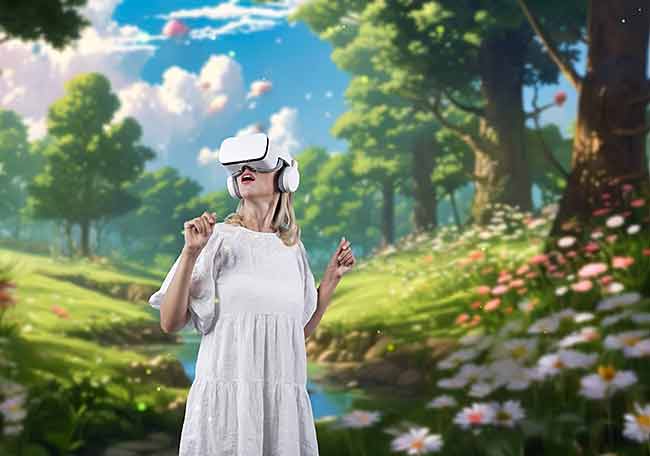
Exploring virtual natural worlds with VR?
And with VR, of course, you can also experience wonderful virtual nature scenes. There are also a whole range of apps that make this possible, for example Itinerant , BRINK Traveller , Nature Treks VR – to name just a few.
Why am I still ambivalent?
On the one hand, the headsets are still relatively bulky and uncomfortable to wear in the long run. This is the case with the new Meta Quest 3 (Advertising) has gotten a little better, but wearing it is not really comfortable in the long run (yet).
On the other hand – and this is the far more important reason – I don't have the feeling of having new energy after such a VR experience. On the contrary, it's more like I have the feeling that I have less energy after "staying" in virtual reality.
But maybe that simply has to do with the lack of comfort. I find the possibilities that such VR applications offer fascinating.
For older people or people who cannot travel long distances due to illness, such VR applications could be a way to experience nature at least a little more intensively.
In fact, there are even Studies , which show that older people can benefit from such virtual nature experiences.
And what should not be forgotten: Even if we are "really" in nature, we experience all impressions of nature through the filter of our senses - so ultimately somehow virtually.
What is your opinion on such VR applications? I would really be interested to know what you think about this! Feel free to write me a comment under this article.
Books
From the high-tech media back to the classic world of media: novels, travel reports and illustrated books.
Because they also have the potential to deepen our relationship with nature and thus bring more nature into our lives.
I already experienced how great this potential is in my childhood days. At that time I had two books that I considered my own personal treasures and both of which are still on my shelf today:
"The Great Atlas of Animal Life" and "Through Nature with Yogi Bear".
I spent several hours leafing through the two books and dreaming myself into the world of these books.
"Through Nature with Yogi Bear" is mainly set in Yosemite National Park in the USA – maybe that explains my passion for the US national parks.
Both books have deeply influenced me with their graphics and illustrations of nature.
Pictorials
Offer even more impressive nature shots Pictorials (Advertising) , which are available on almost every nature topic.
I have already mentioned several times that even looking at nature photographs has a positive effect on our well-being.
Illustrated books are therefore another very good way to bring more nature into your life.
There is hardly anything better than sitting in a comfortable armchair in the evening instead of in front of the TV with a great illustrated book and putting yourself in the wonderful landscapes depicted in these illustrated books.
But illustrated books are of course not the only books that are suitable for this.
Novels and Travelogues
Who doesn't know the American author Jack London , who writes in his books about the gold rush in Alaska ("Lure of Gold") or the wilderness of the Rocky Mountains ("Wolf's Blood", "The Call of the Wild")?
Or Mark Twain's "The Adventures of Huckleberry Finn" and "The Adventures of Tom Sawyer", in which the author describes the experiences of the two boys on and on the Mississippi in the 19th century?
Such books are suitable for igniting a deep-rooted love for nature in us, because they show us how much freedom we can find and experience in nature.
The books of John Muir , many of which are unfortunately only available in English, also belong to this category.
Muir, who is of Scottish descent, is known as an author, botanist, zoologist, glaciologist and environmental philosopher and is often referred to as the "father of the national park idea".
The works of the American poet, author, naturalist and environmental philosopher Henry David Thoreau belong to this category of books that are suitable for awakening a deep understanding and a deep connection to nature in us.
"If you want to feel comfortable, then make sure to be in harmony with every mood of nature."
Henry David Thoreu in "Walden, A Life with Nature"
His novel " Walden. A life with nature ” (Advertising) , in which he writes about his life far from civilization in a log cabin on Lake Walden in Massachussets, where he had lived for over two years.
But of course there are also many modern stories, novels and travel reports that can bring us closer to nature.
Just to mention Andreas Kieling ́s " Through wild Germany ” (Advertising) or Norbert Leitner ́s " At home in nature: stories from the outdoors ” (Advertising) .
In the Anglo-American world, a very special literary direction has now emerged on the subject, the " Nature Writing “.
This special literary genre is about putting personal experiences from and with nature into words and processing them in writing.
Here in Germany, nature writing, or writing about nature, is not yet so widespread. But it will be interesting to see what new works in this special literary genre the coming years have in store.
Because such books are suitable to stimulate our imagination and to create inner images of nature in us, which can create a deep connection with nature in us.
Fortunately, there are already some things in the German-language literary landscape on the topic of "Nature Writing" – see the two books by Andreas Kieling and Norbert Leitner already mentioned.
Simply enter "nature, travelogues" as search terms on the book platform of your choice, and you will get more examples of books in this interesting literary genre.
Pets
Pets - whether dogs, cats, small mammals, birds, fish or reptiles - are of course also a good way to bring more nature into life.
Actually, it's a very good possibility.
Dogs in particular not only make us spend a lot of time with our four-legged friends, they also encourage us to spend a lot of time in nature - in all weathers.
However, it is no coincidence that I list the pets here as the last point of my article.
Because taking in a pet comes with a lot of responsibility. Much more than many people realize when they get a pet.
The result: Far too many of these animals end up in the already overcrowded animal shelters - for the affected animals usually an experience associated with a lot of suffering and pain.
I have therefore actually only included the item pets in my list to make a request to you:
If you're thinking about getting a pet, be clear BEFOREHAND what that means. How much time, energy and money you have to invest so that your new friend can really feel comfortable with you in the long term.
Then, however, pets are a wonderful way to build a deep connection not only with (your) animal, but also with nature as a whole.
In any case, I am grateful to my dog Jacky every day for the many, many hours I was able to spend with him and for the fact that he has been a loyal friend and companion to me for many years.
Result
In this article, I've shown you a number of ways you can bring more nature into your life, even if you don't have impressive natural landscapes right on your doorstep.
Some of them can be implemented relatively quickly, others may be a bit more complex.
Just start with what appeals to you the most and what feels right for you.
Because:
Deepening and strengthening one's own connection to nature is an ongoing learning process, which is always about finding one's own way and one's own access to nature.
Then nature can become a true source of strength and inspiration in your life – because our relationship with nature is always a mirror of our relationship with our own nature.
Because we are a part of nature.
Of course, there are plenty of other ways you can strengthen and consolidate this connection to nature.
Techniques from the Huna or from various coaching areas, for example, which are wonderfully suitable for this purpose.
However, since the description of such techniques would be too long, there will be separate articles.
End
This brings us to the end of the series of articles "Where does nature go here?".
When I wrote the first few sections, I had no idea how long the whole series would eventually become.
Originally, I just wanted to write a normal, small blog post on the topic.
In the course of writing, however, I realized how much there is actually to say on the subject. And so a small article became a total of three articles – and three articles for quite a long time.
I hope you'll forgive me for not being shorter.
For the next blog articles, however, I have firmly resolved that they will only be articles that deal with individual aspects of a topic, so that the reading time for the articles does not get out of hand.
Promised! 😉